
2020-25
This video is constructed from Zoom recordings at an artist’s residency in Cyprus that took place between the first and second lockdowns in 2020. I induced feedback in Zoom by setting up a meeting with two inputs – laptop and phone – recording the results.* In the edit I combined this with audio documentation of an argument about Covid in a group tai chi session a day or two later. In 2025 I added an AI generated ‘reconstruction’ of the verbal exchange.
Shot between the George Floyd Uprising and the Capitol siege, Civil War seems to catch the pandemic’s weird state of exception. Everything is heightened but also derealised. A sense of polarisation, confusion, urgency and dread. Heightened existential awareness meets diminished (ir)responsibility. The possibility of documentary, consensual reality, truth or even simple self-preservation through collective protocol (to mask or not to mask?) – everything is in question, even tai chi itself.
*I refined the technique in 2021 for the video I am sitting in a Zoom
Boom, labubu!
28 November 2025
28 November 2025
If every labubu is a unique surprise...
Boom,
labubu!
Verse 1
Charli was a teacher in UK HE
but one day they XCX’d her.
Got herself a job in a factory
working 996 far across the sea.
Working 996 in the factory
making cute labubus for you and me
Verse 2
One day Dua joined her, new girl on the line
packing dolls in boxes one at a time.
“Wouldn’t it be cool,” she says with a wink
“if things could really boom – just not how they think?”
Chorus 1
“Boom boom, labubu!
baby, bye bye!
Boom boom labubu.
I think we could try?”
Verse 3
Way back west & deep in decline
Trump is on top but
Bibi’s on the line:
“Yes, yes King Don, we’ll stop it, be cool
Just send us some more …aid
So we can blow up this school?”
“Sure thing, Bibi, baby
well what can I say, you know we’ve got your back
have a beautiful day.
Wait a minute – I’ve just had a thought
I’m going to send a little something
just to show our support!”
[to aide: ‘Send Mr Netanyahu… the best labubu they got!)”]
Chorus 2
“Boom boom, labubu!
Bibi – buy buy!
Gonna smile so hard
I think he might cry”
Verse 4 / break
Charli looks at Dua:
“What you trying to say?
You know I love to Vroom Vroom
but we can’t drive away.
We’re not Thelma & Luigi
or Bonnie and Clyde.
If we break out of here,
we’ve got nowhere to hide”
“Wait a minute, Charli,
there’s some thing you should see.
Things aren’t quite as bad
as they seem to be.
If every labubu is a unique surprise
maybe we can break out
without going outside?”
Chorus 3
“Boom, labubu!
Bibi, bye bye
Boom boom, labubu!
but she’s on our side” [Xí’s on our side]
Verse 5
Back in Washington
Seems all is not well
Trump is scowling
Like his gift went to hell
“Get me that labubu company,
nobody gets to take out my buddy Bibi!”
But guess who’s down at Pop Mart for a visit today?
“He looks like a labubu
but from farther away?”
“He’s not quite a labubu,
More like Winnie the Pooh!”
“Nihao Mr President,
how the f*ck do you do?”
Chorus 4
“Boom boom, labubu!
Bibi, bai bai!”
“习救我们?
还是必須自救?”
“Xí jiu women
ao bi xu zijiu?”
“Is she gonna save us or must we all try?”
“Ming ming bai bai!”
[It’s very clear]
+++
Verse 1
Charli was a teacher in UK HE
but one day they XCX’d her.
Got herself a job in a factory
working 996 far across the sea.
Working 996 in the factory
making cute labubus for you and me
Verse 2
One day Dua joined her, new girl on the line
packing dolls in boxes one at a time.
“Wouldn’t it be cool,” she says with a wink
“if things could really boom – just not how they think?”
Chorus 1
“Boom boom, labubu!
baby, bye bye!
Boom boom labubu.
I think we could try?”
Verse 3
Way back west & deep in decline
Trump is on top but
Bibi’s on the line:
“Yes, yes King Don, we’ll stop it, be cool
Just send us some more …aid
So we can blow up this school?”
“Sure thing, Bibi, baby
well what can I say, you know we’ve got your back
have a beautiful day.
Wait a minute – I’ve just had a thought
I’m going to send a little something
just to show our support!”
[to aide: ‘Send Mr Netanyahu… the best labubu they got!)”]
Chorus 2
“Boom boom, labubu!
Bibi – buy buy!
Gonna smile so hard
I think he might cry”
Verse 4 / break
Charli looks at Dua:
“What you trying to say?
You know I love to Vroom Vroom
but we can’t drive away.
We’re not Thelma & Luigi
or Bonnie and Clyde.
If we break out of here,
we’ve got nowhere to hide”
“Wait a minute, Charli,
there’s some thing you should see.
Things aren’t quite as bad
as they seem to be.
If every labubu is a unique surprise
maybe we can break out
without going outside?”
Chorus 3
“Boom, labubu!
Bibi, bye bye
Boom boom, labubu!
but she’s on our side” [Xí’s on our side]
Verse 5
Back in Washington
Seems all is not well
Trump is scowling
Like his gift went to hell
“Get me that labubu company,
nobody gets to take out my buddy Bibi!”
But guess who’s down at Pop Mart for a visit today?
“He looks like a labubu
but from farther away?”
“He’s not quite a labubu,
More like Winnie the Pooh!”
“Nihao Mr President,
how the f*ck do you do?”
Chorus 4
“Boom boom, labubu!
Bibi, bai bai!”
“习救我们?
还是必須自救?”
“Xí jiu women
ao bi xu zijiu?”
“Is she gonna save us or must we all try?”
“Ming ming bai bai!”
[It’s very clear]
+++
PROJECT: BOOM, LABUBU!
PROJECT: BOOM, LABUBU!

Exploring the proposition that (pace Helen Macfarlane, Marx’s first English language translator of Capital) ‘a hideous labubu is haunting Europe – the proletariat’, Boom, Labubu explores refunctioning of the commodity and the détournement of soft power as a way to talk about genocide when it’s been made illegal to speak out.
The song as presented is a hypothetical and minimal iteration of the project’s maximal programme, which was to provide Dua Lipa and Charli xcx with material for a new collab that could shift the Overton Window a little for opposition to Zionist subsumption of western (and not so western) culture, in solidarity with the Palestinian cause and emancipation of Chinese and UK workers.
Released in time for Christmas, Boom, Labubu! was premiered at Chinese art schools and media/visual communications departments in screenings, lectures and workshops in Hangzhou, Chongqing, and Jinan between Christmas Eve 2025 and June 2026.
CAA Hangzhou
School of Communication & Design, 24 December 2025

A talk and screening of Boom, Labubu! and related music-video works exploring the détournement of cultural capital, soft power, and the potential for international workers collaboration amid different kinds of capitalist crisis.
 Revolutionary defeatism as cultural strategy in a world of wars
Revisiting some of my earlier films: putting money on screen in Dead the Ends
 Jiang Jun, Dean of CCA, talks about zero budget film making, Chris Marker’s La jetée and Dimanche a Pekin and Boom, labubu!
 With our hosts Jiang Jun and Cai Wenchao
Boom, labubu! was put into context with earlier works such as You Make Me Feel (1917) and Crisis in the Credit System

20 April 2025
The college hosted an international academic lecture entitled "Hypothetical Imagery: Reconstructing the Context of Platform Reflexivity".
On the morning of April 16th, the academic lecture "Hypothetical Images: Reconstructing the Reflexive Context of Platforms," hosted by the Faculty of Aesthetic Education of Jinan University and organized by the School of Fine Arts and Design, was successfully held in the Fourth Teaching Building. Professor Benedict Smoker, a senior lecturer from Goldsmiths, University of London, was invited as the keynote speaker, and Associate Professor Zhang Xiaojuan from the School of Visual Communication Design of Shandong University of Arts and Design served as the interpreter. More than 100 people, including members of the college's leadership team, relevant faculty members, and undergraduate and graduate students, participated in the learning, exchange, and discussion, jointly exploring the critical and practical paths of image creation in the social media era.
At the beginning of the lecture, Sang Shuguang, Assistant Dean of the College, warmly welcomed Professor Benedict Smoker on behalf of the College. He emphasized that in the context of the digital age, the combination of imaging and cutting-edge technologies such as artificial intelligence is not only an inevitable trend in the development of disciplines, but also an important path for cultivating interdisciplinary innovative talents. He hoped that teachers and students would seize this opportunity for international exchange to inspire their scientific research and creative inspiration.
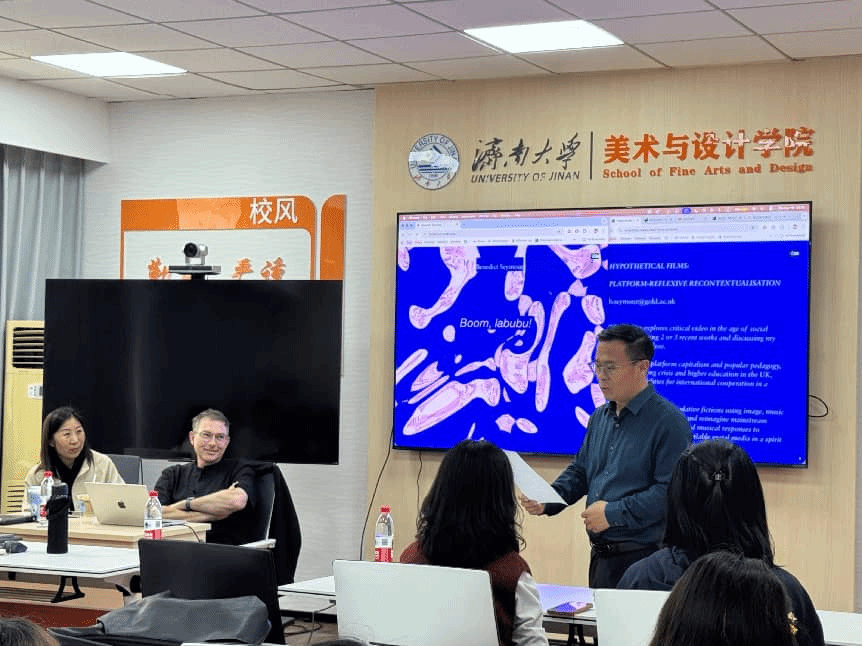
In his keynote speech, Professor Si Mo shared his insights on video creation in the social media era, elaborating on his creative methods and core concepts, and using representative works such as *You Make Me Feel This Way (1917)* and *Boom! Labubu!* as examples. He delved into the creative logic behind his works, discussing real-world issues such as platform capitalization, the UK cost of living crisis, and the current state of higher education. He explained how to use zero-budget visual expression to integrate images, music, and text to construct speculative fictional narratives, thereby reconstructing the mainstream media context and reimagining media forms. Professor Si Mo's use of images, music, and text to construct speculative fictional narratives, and his approach of reconstructing the mainstream media context and reimagining its form, brought new perspectives to the school's faculty and students.
During the interactive session, faculty and students actively asked questions, engaging in lively discussions with Professor Si Mo on current hot topics and the challenges of cross-cultural video storytelling. This lecture, grounded in the forefront of art development in the digital age, focused on in-depth reflections on new media imagery and platform culture, providing faculty and students with an international perspective and cutting-edge academic inspiration. This lecture not only effectively broadened the artistic horizons and creative thinking of our faculty and students but also further promoted international academic exchange and interdisciplinary integration within the college, injecting new momentum and expanding new pathways for academic research and talent cultivation in areas such as integrated painting, contemporary art, digital imaging, and art education practice.
Written by: Zhai Qingqing; Edited by: Li Xin; Reviewed by: He Guiliang

‘Lecture Review | Benedict Seymour: Hypothetical Imagery—Reflexive Reconstruction in the Platform Context Reconstruction in the Platform Context
On the morning of April 28, 2026, the college held an academic lecture entitled "Hypothetical Imagery: Reflexive Reconstruction in the Platform Context" in Lecture Hall 301. Benedict Seymour from Goldsmiths, University of London, was invited as the keynote speaker, and Ms. Zhang Xiaojuan served as the translator. The lecture was moderated by Professor Zhang Hua, and the atmosphere was very lively with active participation from faculty and students.

In his lecture, Professor Si Mo systematically analyzed the new changes in video creation on social media platforms, using the contemporary digital media environment as a starting point. He pointed out that with the continuous strengthening of platform mechanisms, the production, dissemination, and reception of images are gradually being reshaped by algorithmic logic and capital structures. Against this backdrop, images are no longer merely one-dimensional tools of expression, but have become a complex practice embedded in the platform system, capable of both reflection and response . This led him to propose the concept of " platform capitalism . " Professor Si Mo presented several works, including * You Make Me Feel So (1917) * and * Boom, Labubu! *, using examples from his own creative work, and explained in detail his creative ideas and methodologies. In these works, historical images, online materials, and popular culture elements are reassembled, forming new narrative structures through cross-temporal dialogue. He emphasized that this creation is not simply collage or appropriation, but rather an exploration of an expression that lies between fiction and reality, constantly testing the relationship between images and reality.
In addition, Professor Si Mo shared various possible paths for contemporary video creation from a practical perspective , suggesting that the integration of music, text, and visual elements can allow works to not only respond to social issues but also maintain an open and flexible form of expression . At the end of the lecture, Professor Si Mo engaged in an interactive discussion with the faculty and students present on issues such as video creation and international exchange.

This lecture focused on cutting-edge issues in the contemporary media environment and film practice, providing students with a new perspective on understanding the creative logic of the digital age and expanding the academy's ideas for teaching and research in the field of new media art.
Text and photos by Ye Cong
Initial review: Zhang Hua
Reviewed by: Zheng Ting
Final review: Long Wei’
Institute of Visual Arts, Sichuan Fine Arts (SFA) University, Chongqing
April 28, 2026

Lecture Overview
Benedict Simmer's lecture explores video creation in the social media age. This lecture will present his recent works, elucidate his creative methods and concepts, and dissect the production process. Simmer's video works encompass the artist's daily life, including explorations of the operation of social media platforms and the elements contributing to the rise of specific social phenomena. He raises questions starting with certain social phenomena in the UK, while also exploring the experimental creative methods and conscious collage and reconfiguration of materials in video creation in the internet age, and the artistic questions that may be triggered, prompting reflection and inquiries. Simmer emphasizes raising questions in the social reality of the internet age and exploring the various possibilities of international collaboration. The artist uses video, music, and text to construct a speculative fictional narrative, reconstructing the context of popular media and reimagining its form. Simmer excels at using zero-budget visual expression combined with musical composition to explore social phenomena and showcase a playful spirit. His works often respond to events happening around him and reinterpret existing media materials.
In his recent research and film practice, he has focused on cultural exchange and social interaction between Britain, China, and the Far East. Considering the current state of technological development, Si Mo re-examines the symbiotic relationship between people and society, consistently viewing grassroots workers as fellow forces in social development and indispensable collaborators in the exploration of artistic issues. From the 2017 music video *You Make Me Feel So (1917)* to the 2025 work *Boom, Labubu! 2025*, his filmmaking continues to explore and depict the collaboration and re-creation of Eastern and Western media materials, initiating a new type of narrative and cross-cultural dialogue. Artists and workers can collaborate across national borders to jointly conceive a diverse form of contemporary creation.
02—Speaker Introduction
Benedict Seymour
Lecturer and artist at Goldsmiths, University of London
Benedict Seymour is a senior lecturer at Goldsmiths, University of London, an artist, videographer, writer, and musician. His main research areas are urbanization, the relationship between urbanization processes and culture, which he expresses through film, writing, and visual media. His work explores everyday social phenomena, cultural development, interpersonal interactions, and the social impacts of economic development. In addition to teaching and research, Seymour has served as editor of the art journal *Silence*, and his academic and video works are screened by organizations such as the British Film Institute.
Translation Introduction
Zhang Xiaojuan is an Associate Professor at the School of Visual Communication Design, Shandong University of Arts and Design. She has been a visiting scholar at the Royal College of Art (UK) and Northeastern University, Massachusetts. She served as the Director of the China Tour for the American Professional Designers Association's Annual Exhibition of Outstanding Works (2012). She has received numerous awards, including the Shandong University of Arts and Design Teaching Achievement Award, the National Visual Communication Design Forum Outstanding Instructor Award, the International Council of Graphic Design Association Workshop Project Best Award, and the Shandong Provincial Experimental Teaching and Experimental Technology Achievement Award. She has planned and organized several international teaching exchange and cooperation projects.’


+++
LEARNING FROM LABUBU
School of Communication & Design, CAA, Hangzhou
21-25 April 2006

The screening at CAA Hangzhou on 24 December 2026 lead to a 5 day workshop in May 2026 working with students in the visual communications department.
Students responded to Boom, labubu and the technique of refunctioning commodity capital to open up discussion


During the workshop the students created their own short films in response to Boom, labubu! , and Wen Chao designed this (beautiful!) poster


Boom, labubu! Chinese translation:
Stills:


In lovely blue
with Xiaojuan Zhang, 2022
Frances Kruk already said it: I ordered a hurricane and I am still on this island.
2 or 3 things I know about clouds and power in October 2022.
Shot in Greece and UK, this is a sketchy meditation on the blue of the heavens, the systematic confusionism and terror under which we live, dead auteurs and whited out retail windows as the economy shifts into a new kind of ‘death spiral’.
Holderlin wanted to run away from Germany to Greece but only got as far as France. He realised it was more Greek than Greece itself, and stayed put. We ran away to Greece but found it occupied by cops and Californian algorithms; kind of the UK but more so, and first.
Wikipedia kept us (in)sane but still this was no garden of Eden. More an airbnb compound by the sea where we researched Abraham and Sarah and the Old Testament of everyday life – call it ‘contracting social reproduction’.
The impossibility of travel under the cloud brought us back home, by a commodious vicus of recirculation, to an unanswered phone call to the Mental Health system about a mad woman in my ends – my successfully failed attempt to be of use to her.
I cut this bit out but you can still hear the ‘holding’ music – and in the end that’s key to the image of the moment (until the cloud consumes the telephone & its proletariat completely)? Forget about the loading gif, when you’re really fucked they ask you to call then put you on hold.
With the completion of the Tory-Labour merger, the sky not not falling on our heads (the hurricane you ordered...), negatives double or quadruple. But we’re not all volk, right?
Thanks to my collaborator Xiaojuan Zhang, and to Danny Hayward for added inspo.
JLG: RIP. Isou, IOU.
The video premiered at Dwelling on the Cloud, a group show at Lovely Duck, London 24-27 Nov 2022.
Second Wave
July 2020
Premier: Kunsthalle 3,14 Bergen, 20 August 2020
A new – contracted and s(p)ite-specific – edit of One Nation Under A Grave (2020), for a
pop up art show in Bergen mid-pandemic.Second Chapter at Kunsthalle 3,14 in Bergen.
This version notes the structural identity of the logic of Brexit and the logic of the pandemic under the reign of homicidal laissez-faire (make work and let die) capitalism.
Both Brexit and the Tory management of covid 19 are mechanisms decreeing expanded social murder for increased short term profits (and longer term collapse). Both, as mythologies and mechanisms for a right shift, stage a Reichstag fire for the age of social media and social distance. They are ‘freedom games’ in which the rich get richer and the poor die at an accelerated rate, all in the name of your freedom to (insert class specific fate: work/shop/etc).
This mechanism is built into the form and ‘address to viewer’ of the video, which was shown in a Bergen gallery at a time when it was questionable that any public space should be open, and during which, as film-makers / artists, we found ourselves needing to pressure the institution to make the viewing experience safer, in the end only their laid back promotion of their own pop-up protected the potential public from their idea of a ‘socially distanced’ (ie side by side) seating arrangement. This anticipated similar wrangles in Cyprus & UK art spaces (see later videos).
As a social relation (necessarily incorporating ‘institutional critique’ or ‘anti-relational aesthetics’?) this edit of One Nation Under A Grave testifies to the universality of the homicidal drive of late neoliberal /para-fascist regimes that impose work and sustain middle class cultural consumption without paying for the mass suspension of labour necessary to actually end a pandemic. We hadn't been pro-Corbyn for so very long before the election; in turn, the pandemic would make us nostalgic for Fidel Castro. But of course, the answer is neither Washington nor Havana nor even Beijing capitalism (etc) but global communism.
This version notes the structural identity of the logic of Brexit and the logic of the pandemic under the reign of homicidal laissez-faire (make work and let die) capitalism. Both Brexit and the Tory management of covid 19 are mechanisms for expanded social murder and increased short term profits. Both, as mythologies and digital mechanisms for a ‘right shift’, stage a Reichstag fire for the age of social media and social distance. They are 'games of freedom' in which the rich get richer and the poor die at an accelerated rate, all in the name of your freedom to (insert class specific fate: work/shop/etc).
I am sitting in a Zoom
March 2021
A Zoom lecture performance reprising Alvin Lucier’s 1969 minimalist sound work I am Sitting in a Room for the moment of covid lockdown, George Floyd Uprising, and Capitol siege.
By joining a single Zoom meeting with two different inputs (phone and laptop), the performer provokes the platform into a form of positive feedback, a self-inflicted Zoom bombing.
Cybernetics derives from kybernetes, the Greek work for steersman, and studies organization, communication and control in complex systems by focusing on circular (feedback) mechanisms.
Commissioned for the online conference Dysfunctionalities in Art at EKATE, Nicosia, Cyprus, 13 March 2021.
See also: Civil War
Short Circuits: Finance, Feedback and Culture,
Mute Magazine, 2011. Lecture version: Goldsmiths, University of London, 2015.
One afternoon in E9 in 2015, by grace of airbnb (and B and R and B), a suite of one-take instasongs.
The action is social but the mind is private. We were nothing but we
must have been everything.
Music:must have been everything.
ben Brown – percussion
rachel Baker – vox
benedict Seymour – piano
Words:
Joshua Clover (Red Epic), EE Cummings, Karl Marx, Alfred Sohn-Rethel, etc

TRAUM
| 2011- 2014. Traum was Benedict Seymour, Cameron Bain, Rachel Baker, Kathryn Davies. All songs composed and (mostly) performed live to hard disk recorder in Homerton, E9. Vocals, Harmonica, additional Keys – Rachel Baker Guitar– Cameron Bain Sax, Accordion – Kathryn Davies Piano, Keys, Drum machine – Benedict Seymour |
| Drums on I Read the Runes – David Panos |
| Minimal or zero editing. |
| Traum played only a handful of live gigs, but one reviewer says: ‘That Traum gig you did was a highlight in my life.’ – Dr Dimitra Kotouza |
“The genuinely revolutionary element in his music is the transformation of the function of expression. Passions are no longer faked; on the contrary, undisguised, corporeal impulses of the unconscious, shocks, and traumas are registered in the medium of music. […] Schoenberg’s formal innovations were closely related to the change in the emotional content.They serve the breakthrough of its reality. The first atonal works are depositions, in the sense of psychoanalytic dream depositions. […] Real suffering has left behind [scars, disfiguring stains, “in opposition to the compositional will,” that cannot be wiped away] in the artwork as a sign that it no longer recognizes its autonomy; their heteronomy defies the self-sufficient semblance of music. [...]
What radical music knows is the untransfigured suffering of men whose powerlessness has so increased that it no longer permits semblance and play. […] The avowal of hatred and desire, of jealousy and forgiveness and beyond that is the whole symbolism of the unconscious, is wrung from [the protagonist of Erwartung]; and only in the moment of her insanity does the music recall its right to console. Yet the seismographic record of traumatic shock at the same time becomes the technical law of music’s form. It forbids continuity and development. The musical language is polarized into its extremes: on the one hand, into gestures of shock—almost bodily convulsions—and on the other, into the brittle immobility of a person paralyzed by anxiety.”
– Theodor Adorno,
Philosophy of New Music
PETIT MAL
2003-10

Petit Mal were Benedict Seymour and Melanie Gilligan, 2003-10
Crisis in the Credit System
Single (7” vinyl /mp3) on Difficult Fun DF007 Nov 3, 2008

First/last/only pop song about the 2008 financial crisis?
And just before the ground expires
the past is consumed in fire and grief,
grief will be far too late
the whole world will share your fate
and take the fall for you

Petit Mal / Petit Mal LP
 |
2009, CD and mp3 on Difficult Fun records DF006
Track list:
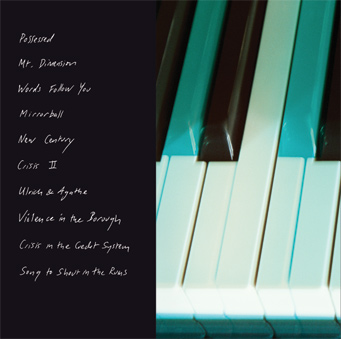
1 Possessed 2 Mt. Dimension 3 Words Follow You 4 Mirrorball 5 New Century 6 Crisis 2 7 Ulrich & Agathe 8 Violence In The Borough. 9 Crisis In The Credit System 10 Song To Shout In The Ruins | |
| Music composed and performed by Benedict Seymour Vocals, lyrics – Melanie Gilligan Additional bass – David Panos Produced by – Benedict Seymour Mastered by – Doug Shearer Artwork (inside cover) – Josephine Pryde |
|
2005 Petit Mal ‘Crisis II’, on Und Jetzt Alle, Text Zur Kunst Sounds,
Compilation, Text Zur Kunst no.60.

CD accompanying the 60th issue of the German art magazine Texte zur Kunst, which was dedicated to Sound in Art
2005 Petit Mal, ‘Mirrorball’ on Game and Errancy Compilation LP & Zine · DF004 vinyl.

| ‘... A close runner-up is "Mirrorball," by Petit Mal. Some will say that this smacks of Chris & Cosey, but I prefer to think of them as Captain & Tennille meets Malaria, with lyrics by Robbe-Grillet.’ – The Other Music update, September 22 , 2005 | ||||
LIVE
13 August 2010 Petit Mal live performance at Walter Phillips Gallery, The Banff Centre, Alberta, Canada. Opening event for Popular Unrest, exhibition by Melanie Gilligan, and the Banff Summer Arts Festival.
19 November 2009: Petit Mal live performance at the ICA, London supporting The Red Krayola.
24 September 2009: Petit Mal live performance Karlsruhe Kunstverein for launch of exhibition ‘The Last Days of Jack Sheppard’, Anja Kirschner & David Panos.
9 May 2009: Petit Mal live session for Choking on Cufflinks on WFMU radio, Jersey City, NY, USA. https://www.wfmu.org/playlists/shows/31391
Some or all of the set is available on Free Music Archive. Listen here
1 Mt. Dimension
2 In Mexico
3 Crisis In The Credit System
4 Possessed
5 They Hate Us
6 Wild Is The Wind
Producer: Michael Goodstein. Engineer: Trent Wolbe
‘Part of the Difficult Fun UK DIY art collective which also birthed Antifamily and Asja Auf Capri, Petit Mal are an overeducated synth pop duo. Their newest single “Crisis in the Credit System,” calls to mind a bit of Young Marble Giants, a bit of Robert Wyatt's pop for Rough Trade, and a little bit of Yaz or early Adult if they were more interested in systemic risk rather than relationship drama.’
https://freemusicarchive.org/music/Petit_Mal/discography
6 May 2009: Petit Mal, live performance at Grey Room event at Issue Project Room, New York USA. With Emma Hedditch, Jutta Koether and Tony Conrad.
February 2009: Petit Mal – Petit Mal
12 track album out on Difficult Fun records (CD only).
Written and performed with Melanie Gilligan. Tracks available online:
‘Mount Dimension’ fan video by Ben in Kassel
2 January 2009: Petit Mal live performance at Late at Tate, Tate Britain, London
19 July 2008: Petit Mal, live performance, Analog Festival, Dublin, Eire.
27 April 2008: Petit Mal, live performance, Glasgow International Festival.
Closing party, CCA Glasgow, Scotland.
New band of the week, The Guardian 10 Sept 2008, Paul Lester

‘No 387: Petit Mal
You don't have to have a working knowledge of socio-economic structuralism to enjoy this nerdy electro-pop duo, but it may help
Hometown: London.
The lineup: Ben Seymour (synths) and Melanie Gilligan (vocals).
The background: Petit Mal may be an electro-pop duo comprising one boy and one girl, but The Ting Tings they are not. Their debut single isn't called "Oi! DJ Shut Up and Let Me Dance" or anything like that. No, it's called Crisis In the Credit System and, notwithstanding Stereolab's socio-political messages and Marxist critiques, it's the first pop song about the credit crunch, even though it was actually written two years ago. Which makes them not just brainier than The Ting Tings, but more prescient, too.
They must be brainy because one of them, Ben Seymour, is the Deputy Editor of online publication, Mute, who recently wrote something about regeneration and gentrification in London, made a film on the subject and worked on a series of photo-essays on the restructuring of the capital's East End while creating a research database for "antagonists of contemporary urbanism". Meanwhile, his partner Melanie Gilligan, hardly a dunce herself, is a sometime filmmaker who penned an article, Slumsploitation - The Favela on Film and TV, on "the cinema of slums" (eg City Of God), that explored the difficult subject of "whether representation is the answer to 'social exclusion' or one of the mechanisms of its reproduction". Blimey. As synthpop duos go, Petit Mal make the Pet Shop Boys look a bit, well, thick. One of their songs is called Mt Dimension and features a line about "Escher-like cross-characterisation". Petit Mal have been labelled "Chris & Cosey meet Malaria, with lyrics by Robbe-Grillet". And not for nothing. Robbe-Grillet was a French writer (he died in February) whose style was described as "phenomenological". Enough said.

And yet, and yet ... You can dance to them. Just. "Petit mal" is used to mean seizure, the sort that occurs during epilepsy, but you don't have to jerk manically like Ian Curtis while their music is playing. They've got that arty/accessible duality down pat, the sort that early '80s synth-duos used to have, so that before you even realise it, you're humming and moving along to ideas that are quite high-falutin' and complex. While the electronic melodies are easy on the ear, the lyrics are likely to be about how "grief is a curious state" or somesuch. Crisis In the Credit System might be sung with Teutonic dispassion by Gilligan, and it might be about "the mysteries of the global financial system ... based on a prophecy of financial apocalypse", but it's accompanied by a lovely melancholy tune and a finger-clicking electronic beat. Yes, the single will be featured in a four-part fictional film of the same name that Gilligan has scripted and directed (to be released online on September 29), one that makes connections between Northern Rock and Das Kapital, but that doesn't make it any less enjoyable, even if a working knowledge of capitalist imperatives and socio-economic structures is recommended.
The buzz: "The most interesting and forward looking artists on the avant-electronic underground pop scene!"
The truth: Erudite disco can have mass appeal – remember, the Pet Shop Boys used to reference Che Guevara and Debussy on their hits...
Most likely to: Seize the means of production.
Least likely to: Induce seizures – this music really is just standard, infectious electro-pop.
What to buy: Crisis In The Credit System is released by Difficult Fun on October 13.
File next to: Pet Shop Boys, Tears For Fears, OMD, Yazoo.”’
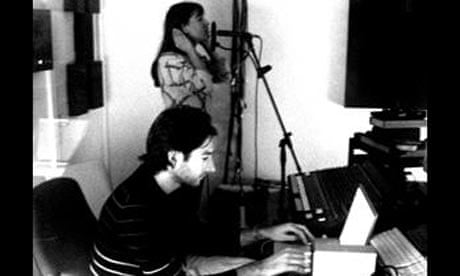
Highbrow electro ... Petit Mal in the studio
Melanie Gilligan’s film, Crisis in the Credit System (soundtrack Benedict Seymour) - review by Dan Fox in Frieze magazine:
‘I am entirely unqualified to say whether the film engages successfully or not with the complex systems of futures, derivatives and hedge funds, so if I have any reservations they are minor aesthetic ones. The task of articulating the broader themes occasionally has a clunky effect: characters tend towards stereotypes (in one instance, a brash businessmen boasts: ‘I crave the battle’, which somehow comes across more like Stephen Fry and Hugh Laurie’s health club managers than Michael Douglas in ‘Wall Street’) or struggle to deliver lines about abstract financial theory without sounding like they’re reciting from a textbook. Although the ‘Crisis in the Credit System’ theme tune by Petit Mal (Gilligan and writer Benedict Seymour) is fun and reminds me a little of The Red Krayola’s soundtrack to 1980s feminist sci-fi film ‘Born in Flames’, it is a little too retro-sounding – I felt it needed to be as steely and corporate as the film’s graphic title sequence, rather than reminiscent of Stereolab’s fusion of Marxist theory and Francoise Hardy.’
The Guardian, 8 November 2008. ‘Louis Pattison's new releases review: Petit Mal, Crisis In The Credit System (Difficult Fun)’
‘Pop music, being an industry that earns its groats from celebrating the most blithely idiotic forms of hedonism, has so far been relatively quiet on the subject of the sub-prime mortgage crisis. Here, however, London electro-poppers Petit Mal ponder recession with eyebrow curled. "Grief is a curious thing," they announce, coolly, over spirals of synth, and the whole thing is oddly serene in its grave seriousness, like a hedge fund manager noting the eerie silence somewhere between his 31st floor window and the rapidly approaching pavement.’
Contribution to the Critique of Romantic Love
Unreleased Petit Mal track covered by Traum, 2013:
ANTIFAMILY
Antifamily LP

LP (vinyl and CD) released on Difficult Fun (DF005), 2006.
Core members: Benedict Seymour, Rachel Baker, Melanie Gilligan, Anja Kirschner, David Panos, Jamie King.
‘Antifamily are a collective of artists operating both in the U.K. and Europe. I stress “artists” because they are not only musicians, but Marxists, painters, poets ... the list goes on. This LP, self-titled and released on London label Difficult Fun, utilizes 10 of those artists to create an effectively politically-charged post punk album.’
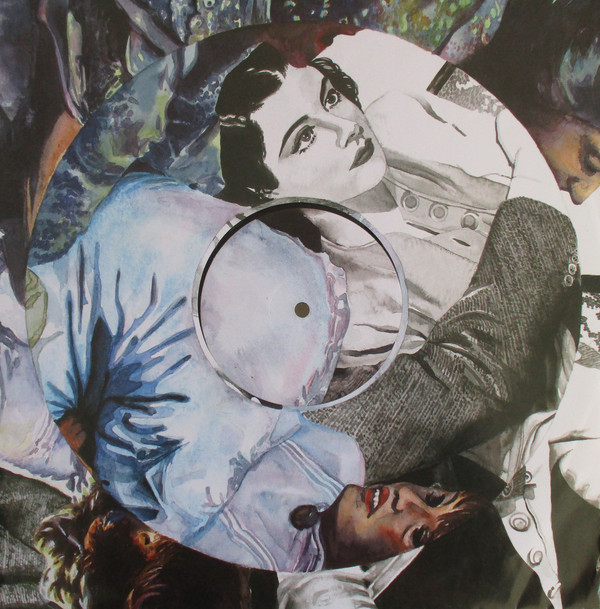
Front and back cover artwork by Anja Kirschner.

Inner sleeve by Pauline Broekman
Track list
| A1 | Law Of The Plainsmen |
| A2 | Work Cheap |
| A3 | The Shaft |
| A4 | Same Old Same |
| A5 | J'Avance |
| A6 | The Liberation |
| B1 | Prima Luce |
| B2 | Nation Of Bastards |
| B3 | Without Delay |
| B4 | Power Gets Less |
| B5 | I Of The Law |
| B6 | The Final |
| B7 | Obscene Mist |
Bass, Drums, Guitar – Jamie King (2)
Bass, Drums, Guitar, Keyboards, Piano – Martin Munch*
Bass, Guitar, Keyboards, Piano – Benedict Seymour
Vocals, Bass, Keyboards, Piano – Rachel Baker
Vocals – Melanie Gilligan, Anja Kirschner, Agnese Trocchi, Juliette Savin
Drums, Electronic Drums, Piano, Producer, Editor – David Panos
Saxophone – Dennis Dubovtsev
Producer [Post-Production] – Nick Phillips (2) (tracks: 2, 8)
Mastered By – Doug Shearer
Improvised straight to hard drive in London & Munich 2004-6. Minimal overdubs added.
Artwork – Anja Kirschner, Pauline Van Mourik Broekman, Tina Borkowski, Benedict Seymour, David Panos.
Antifamily EP
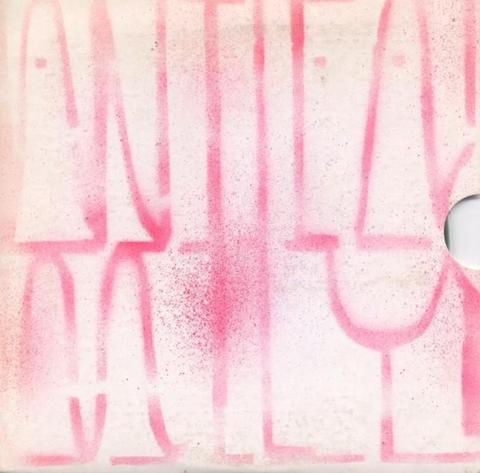
EP (CD) 2004.
Track list
| 1 | Instructions |
| 2 | Staring At A Point |
| 3 | Fast Fixed Relations |
| 4 | C1ty L1ghts |
Bass, Guitar, Synth, Editing – Benedict Seymour
Vocals – Rachel Baker
Vocals – Melanie Gilligan
Bass, Drums, Guitar – Jamie King
Drums, Electronic Drums, Piano, Producer, Editing – David Panos
Artwork – Melanie Gilligan
Recorded in London 2003
Antifamily website (2002-3):

Early recordings retrieved from the Antifamily website
Track list
Hable Ingles
Mission: Obscure
Gun/Camera Days at the base of the pit
Subject of the statement
The love and empathist is like an insect
Fall on the sword you live by
Guitar, Bass – Benedict Seymour
Drums, Bass – Jamie King
Bass, Guitar, Synth, Producer, Editing – David Panos
Vocals – Agnese Trocchi, Rachel Baker, Howard Slater,
Matthew Hyland
Antifamily is an art/music collective on London's Difficult Fun label. These are some unreleased tracks featured on their website at http://www.antifamily.org/1.html
‘I blame WFMU for infecting me with my first taste of Antifamily. “Staring at a Point” from the self-titled EP came on the radio and I was hooked. I started exploring antifamily.org and quickly found myself obsessed with their intricate DIY methodology. An UK-based collective that holds four members at its core but has included up to 15 different participants. Utilizing people who have never sung or played before. An improvisational spontaneity reined in with editing and production. Each song is an artifact of a band in continuous flux. Antifamily stride the acerbic, detached, anxious, cathartic, and brittle with intellect and innovation. Distancing the likes of Erase Errata and Numbers with a nod toward Lilliput, Can, and Velvet Underground along the way. Syncopated repetition, guitar flourishes, electronic hooks, and lyrical content are all part and process of an actuated dialogue where obscurantist tactics flirt with convention in a trialectic loop of art, philosophy, and music.’
– Other Music
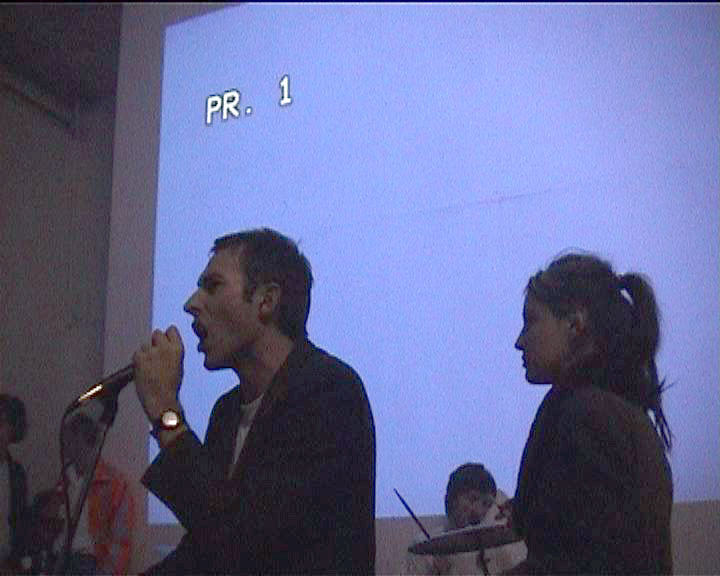
Antifamily live at Tourette's, W139 Amsterdam October 31st 2003. Thanks to Rod Dickinson
Rome is not a city

Rome is not a city (2006) collected on Zum audio vol 3, compilation CD/ mp3 released Jan 5th 2008 on Zum
Guitar – Benedict Seymour
Vocals – Agnese Trocchi
Drums – Jamie King
Bass, Synth, Producer, Editing – David Panos
Prima Luce

Prima Luce on Difficult Fun EP, DF001
Bass – Benedict Seymour
Vocals – Agnese Trocchi
Drums – Jamie King
Bass, Synth, Producer, Editing – David Panos
SNAKES
(1999 -2001)

Snakes/ Snakes LP
Unreleased LP, 2001. Produced by Bruce Jones.
Commie (versus) libertarian rock’n’roll:
Benedict Seymour – Guitar
Nicholas Brooks – Drums
Jamie King – Vocals
David Panos –Bass
Aug 2002: ‘Little Machine’, track on 4Eva – A tribute to fanaticism, compilation CD, The Physics Room, NZ.
Audio CD Catalogue of Physics Room web project. Produced 2000.
The internet has spawned a style of website known as the tribute or fan site. 4Eva is a shrine to this endearing, sometimes desperate, often more personal style of mania. Fan sites have proliferated and loved ones, pets, philosophers, books, religious extremists, terrorists, gurus, separatist guerrillas, porn stars and rock groups, among others, have been immortalised by their fans or followers. Designed and built by artists with an interest in such unconditional tributes and declarations, 4Eva is itself an investigation of the expression of everyday admiration, respect that the world wide web has enabled. These artists have recorded material in their bedrooms and garages, making it available on the world wide web for all to see. 4Eva has been realised as a internet interface accessible through The Physics Rooms website. Available for purchase is the catalogue in the form of a limited edition audio CD.
4Eva and all other Physics Room publications are available from the gallery at 209 Tuam St in Christchurch, Parsons Bookshop in Auckland, or by mail order.
Moderation (2016)

Petit Mal (B.Seymour and Melanie GIlligan) contributed the track ‘Possessed’Set in Egypt, Greece and Italy, Moderation (2016) revolves around a female horror director and a screenwriter whose latest collaboration is haunted by encounters with its ‘raw material’ and the escalation of conflicting desires.
Faced with the disintegration of their project, the director becomes more and more drawn into conversations with the actors she has cast, which reflect on the way horror traverses the affective and material realities of their lives on and off the screen.
The Common Sense (2015)

Dir. Melanie Gilligan. Soundtrack: B.Seymour. 2015
Produced by Outset [Thanks for the cash – now: FREE PALESTINE!]
Elvia Wilke writes about the film on Rhizome, with a clip here
New York-based artist Melanie Gilligan's largest project to date, The Common Sense takes the form of a sci-fi film and mini-series which looks at how minds, bodies, and interpersonal relations are shaped by technological advancements within capitalism. This experimental narrative drama tells a story that revolves around a future technology which allows one to directly experience another person's bodily sensations and affect. After a decade of transforming the conditions of work and social life, for the most part in accordance with economic demands, the technology's networks suddenly fail causing massive disorientation. People withdraw and isolate themselves from the public, no longer knowing how to communicate. Once the system comes back online, the story splits into two scenarios: one version shows a period of normalization after the rupture, while in the other people confront the ways that the technology has been exploitatively used for years, some forming social movements to resist the continuation of these conditions.
—Casco
https://www.deappel.nl/en/archive/events/796-melanie-gilligan-the-common-sense
Aune (2012)

Dir. Maija Timonen. Soundtrack, B. Seymour
Aune is a 19th century girl confined to her bed, living under the threat of amputation. She has dreams of a park that are both premonitions of the future and a site at which its absence is played out. An escalating sense of timelessness collapses Aune's two realities, as her body takes on significance as a cipher for a larger process of dismemberment. A love story turns into a film about sex, death and the economy. Filmed in large part in Victoria Park, London, the film is a loose adaptation of 1896 novel Aune by Finnish writer Immi Hellen.
2010 (Popular Unrest)

Dir. Melanie Gilligan. Soundtrack composed and performed by B.Seymour
Jasper Bernes discusses the film in Mute Magazine
Crisis in the Credit System (2008)

Dir. Melanie Gilligan. Soundtrack: B. SeymourProduced by Artangel.
‘Crisis in the Credit System is a fictional foray into contemporary global market catastrophe, scripted and directed by artist Melanie Gilligan. A major investment bank runs a brainstorming and role-playing session for its employees, asking them to come up with strategies for coping with today’s dangerous financial climate. While diligently pursuing this task, five individuals inadvertently role-play their way into bizarre make-believe scenarios forming disturbing conclusions about the deeper significance of the credit crisis and its effects beyond the world of finance. In the midst of the financial crisis, the employees congregate in a role-play group and introduce themselves to the circle. An artist is present to help them visualise their thoughts. A basket is passed around with different characters for them to embody; videos, books, articles and props are provided.’
The Last Days of Jack Sheppard (2009)

Dir. Anja Kirschner & David Panos. Music for 2 sequences: B.Seymour.
https://chisenhale.org.uk/project/anja-kirschner-david-panos/Chisenhale Gallery premieres a new film and installation by Anja Kirschner and David Panos co-commissioned by Chisenhale Gallery and Centre for Contemporary Arts (CCA), Glasgow. The Last Days of Jack Sheppard is a film based on the inferred prison encounters between the 18th century criminal Jack Sheppard and Daniel Defoe, the ghostwriter of Sheppard’s ‘autobiography’, set in the wake of the South Sea Bubble of 1720 – Britain’s first recorded financial crisis.
WRITING
Selected articles, essays and fiction
July 2020: ‘Dissolving the People’, in How To Win, an anthology of writing and artworks by Tories Out Propaganda Unit (TOPU),
16 May 2020: ‘This isn’t a virus, it’s a time machine’, Mute Magazine:
“Benedict Seymour takes Fredric Jameson’s 2015 essay ‘In Hyperspace’ as a starting point to compare the current UK government’s Covid-19 and Brexit policies – a device to effect a collective leap into the future, only with the twist that this leap into the ‘future’ is actually a radical leap into a reactionary past, a rapid leap backwards.”
– Stefan Kalmár in ICA Daily, 24 May 2020
March 2020: ‘La Rejetée’. Essay-fiction on film, financialisation and social media. In The Memory of it Sometimes Comes to you – Encircling the Image of Trauma, Centre d’Art Contemporain/Archive Books, Geneva. Matei Bellu and Emilie Bujès, eds
September 2018: ‘Art and the Utopia of (Non-)Reproduction’. In: John Chilver and Brighid Lowe, eds. Manual: Parts and Labour. Osan: Gwak Sang-wook, Osan Culture Foundation, pp. 22-23
August 2017: ‘The re-Jetée: 1971, Recurring’
Treatment for a non/reproduction of Chris Marker’s La jetée. Published in WdW Review Vol.1 (2013-16): Arts, Culture, and Journalism in Revolt (book), edited by Defne Ayas, Adam Kleinman. Anthology of Witte de With’s online platform WdW Review since its inception in 2013
September 2014: ‘Primer'’
Speculative fiction on commissioned for the catalogue of the Bergen Biennale. David Riff; Ekaterina Degott and Jill Winder, eds. Monday Begins on Saturday. Berlin: Sternberg Press, 2014, pp. 123-163
April 2014: ‘The re-Jetée: 1971, Recurring’
Fiction-theory for WDW Review, Rotterdam, 1971 section
Sept 2010: Creativity’s Rainbow
Speculative fiction reworking Thomas Pynchon and Philip K Dick’s post-war scifi to imagine the aftermath of the creative class post-austerity and reaction. English and Russian translation in catalogue for Shockworkers Of The Mobile Image, the First Ural Industrial Biennale of Contemporary Art 2010, Ekaterinberg, Russia. Edited by Ekaterina Degot, David Riff and Cosmin Costinas. Reviewed in Frieze magazine
5 Jan 2012: ‘La jetée’s Spiral’
Mute Magazine, review of Les Marques Aveugles at the Centre d'Art Contemporain in Geneva. Modernist film tropes and their afterlife in the loops of post-Fordist restructuring
July, 2011: ‘Short Circuits: Finance, Feedback and Culture’, Mute Magazine, Vol3, no.1. A theory of cybernetics as a mode of non-reproduction of capital, and of Cagean aesthetics as anticipation of neoliberal ‘dematerialisation’ and social reproductive crisis: ‘doing more with less’
July 2010: ‘Eliminating Labour: Aesthetic Economy in Harun Farocki’
Mute Magazine, Vol2, no.16. Devalorisation and the art of destroying (constant) capital
Sept 2009: ‘Something is happening but you don’t know what it is’
Essay in Finance – Stanley Picker Gallery Lectures on Art part 4, by Benedict Seymour and Anthony Davies with Ian Hunt, editor Dean Kenning, pub. Centre for Useless Splendour, Kingston University, London, 2009
12 August 2009: ‘Notes on the Last Days of Jack Sheppard: Capital Crimes and Paper Claims’
May 2008: ‘Blurred Boundaries: Sport, Art and Activity’, Mute magazine, Vol.2, no.8. Loren Goldner, CLR James, Melville and Marx converge on all-sided praxis
2007: Editor, ‘Scum of the Republic – Banlieuesards and the Left’, a short pamphlet on the 2005 riots in France. Published by Mute Books, London
21 December 2006: ‘Drowning by Numbers: The Non-Reproduction of New Orleans’
After the actual hurricane that hit New Orleans in late August 2005, came the second hurricane of neo-liberal looting.
2006: ‘Mutiny in the Mainstream’, Journal of Visual Culture, Volume: 5 issue: 1, page(s): 112-114 https://doi.org/10.1177/147041290600500115
4 April, 2006: ‘Fear Death by Water – the Regeneration Siege in Central Hackney’, The London Particular, Mute Magazine, 26. Artist’s project by Benedict Seymour and David Panos on the racialised gentrification of central Hackney
June 2006: Text and images of regeneration mapping project in Else/where: Mapping — New Cartographies of Networks and Territories, University of Minnesota Design Institute, 2005, ed. Janet Abrams and Peter Hall. Scholarly anthology on techniques and contemporary applications of mapping https://www.upress.umn.edu/book-division/books/else-where
6 March 2003: ‘Involuntary Victims of the Aztecs’
Isomorphisms with contemporary empire at the Royal Academy Aztecs exhibition. Is ours a culture of sacrifice that simply lacks the luxuries granted to the ‘savage’ sacrificial man?
July 2002: ‘Back to Zero’ Mute Magazine 21
Jean-Luc Godard’s Maoist films as ambiguous experiments in (old) new media
10 March 2002: ‘Bio-Pics’ On Pasolini’s Salo, Trilogy of Life, and Agamben, Mute Magazine 23
March 2002: ‘When Worlds Collide’ – article on painter, Nigel Cooke, Frieze 65.
Exploring an art of apocalypse as state of exception
March 2002: ‘Do the Right Thing! The Anti-Globalisation Movement after S11’
Texte Zur Kunst, no.44
10 Dec 2001: ‘The Last Picture Show’ – on closure of the Lux cinema, Mute Magazine, 22.
Rent and artists’ cinema in the east end
10 July 2001: ‘Blockbusting the Election’, Mute Magazine, 20.
May 2001: ‘Nationalise This!’ – Analysis of ‘anti-globalisation’ movement, Radical Philosophy, 107.
April 2001: ‘Two or Three Things I Know About Her’ – Urban regeneration in London, Mute Magazine, issue 19
April 2001: ‘The Battle of Seattle’ for Log magazine: rap about ‘anti-globalisation’
Feb 2001: Review Chad McCail, Laurent Delaye Gallery, London, Frieze 57
Jan 2001: Review Jeremy Deadman, Five Years, London, Frieze 56
Sept 2000: Review ‘Club Circuits’ Southampton, Public Art Journal
June 2000: ‘Rabble Rousers’ - Antonio Negri and Michael Hardt’s Empire, Mute 18
May 2000: ‘Coral Maze’ review of Mike Nelson at Matt’s Gallery, Mute 17
April 2000: Review ‘Wooden Heart’, AVCO London, Art Monthly, 235
Dec 1999: ‘Everything Must Go’, Creativity, capitalism and the ‘CRASH! Corporatism & Complicity’ exhibition at the ICA, Mute 16
Sept 1999: Review Henry Bond, Emily Tsingou, London, Frieze 54
June 1999: ‘Rehabilitating the Subject’ – review of The Ticklish Subject by Slavoj Zizek, Mute 13
August 1998: ‘The Situationist City’ by Simon Sadler, review in Mute 11
‘Fifth Column’ blogs on Metamute.org
8 July 2014: ‘Game of Thralls – an Art & Labour Fantasia’
Organizing in the artworld?
29 May 2014: ‘Notes on Normcore’
A response to Tom Frank's analysis of the normcore trend. Rory Rowan responded in turn in ‘So now – On Normcore’, E-flux! Issue #58 October 2014
April 2014: ‘Domino, No No No!’
Culture and Gentrification in Williamsburg
March 2014: ‘Nuff Aura: Absolute artwork meets absolute desperation’
Hip hop as asset class
Dec 2013: ‘A Christmas gif(t): On gifs, time and the carnivalesque’
April 2013: ‘Keep Calm and Carrion: Two Funerals and a Reflection’
Thatcher death parties in UK
October 2012: ‘Nothing is Better than Love: How not to repeat Weimar in Greece’ Critique of Paul Mason on Grexit
August 2012: ‘Crime Scene Investigation’ Bullets in Broadway Market, Hackney
July 2012: ‘Alternative Olympics’ The London Riots and the Olympics as ‘negation of negation’
July 2012: ‘Anish Kapoor/Vanish the Poor: 3 Olympic Symptoms’
Art and the elimination of labour (aka the working class)
June 2012: ‘Slave to the Rhythm, or The Promissory Form of Labour’
Workfare, mass ornament, and jubilee
THIS ISN'T A VIRUS, IT'S A TIME MACHINE
16 May 2020

Image: Still from Still from Dead the Ends (2017), Benedict Seymour.
In a 2015 London Review of Books essay Fredric Jameson briefly imagines the Bolshevik Party as a kind of time machine. The party is a device by means of which Leninist revolutionaries effect a collective leap into the future:
[H.G.] Wells’s formal innovation … lay in his shifting of the reader’s attention to a technological
substitute for the missing historical transition, namely the time machine. (We might argue that the party was Lenin’s analogous innovation in the realm of political strategy).[1]
If the party staged interruptions in the linear, empty time of industrial capitalism, or at least put the conveyor belt into fast forward, these would be temporal events of acceleration freeing us from the old, breaking us from the feudal past, opening up a future of self-determination.
Today in the UK (and beyond), we are undergoing first Brexit and now Covid as contemporary time machines that really do produce temporal leaps – even if their temporality, which comes on punctual (‘Take back control!’), ends up leaving behind it an endless smear of bureaucracy and technocracy (‘Get it done’, chapters 1 to n). But these time machines are regressive, not progressive: they effect a rapid leap backward – even if this retrogression is absolutely novel.[2] In political and social-reproductive terms these two successive shocks have been coups for a reactionary movement, not least where they have most emphasised their focus on the future. Wherever Tories invoke the ‘state of the art’, for example behavioural (pseudo-) science, in which the hypothesis of ‘herd immunity’ serves to return us to racist eugenics, they always set the controls for the heart of darkness, neo-reaction, cutting edge disaster. Brexit was a kind of far-right coup or contemporary ‘Reichstag fire’ that delivered a fast forward into the past, politically, laying out a new set of terms for the ruling class and the ruled. It managed potential anti-capitalist sentiment in a racialised and technocratic direction, turning righteous hatred of Blairites and Tories alike into something toxic and regressive and so containing and inverting its implicit threat to the system. The Brexit ‘choice’ congealed anger into anti-migrant, late colonialist resentment, an elegant ideological device to suppress a burgeoning sense of class hatred, by pitting proles against each other along lines of age and race. So, the embittered white ‘boomer’ male booms on about the migrants, the woke, the snowflakes and red tape, NOT the bosses, the borders, the Blairites’ attack on social reproduction over decades of cuts to services, subsidies, benefits, etc.[3]
Moving on from the Brexit event to the Covid event, the UK state was always going to be crucial in dealing with a pandemic, there could be no self-organised, grassroots response in the current desperately fucked socio-political circumstances (though compare and contrast Hong Kong or Kerala’s pandemic response to get a sense of how things could be). However, under Johnson’s Tory party, and specifically the Dominic Cummings dominated cabinet, dealing with Covid means a de facto and tacit assault on the working class in the UK that is as racist and necropolitical as it is nerdy and wonkish. It has plenty of room for self-organisation as long as it is decoupled from any antagonism to capital. From herd immunity to… eternity, Covid becomes the pretext not for the libertarians’ nightmare of perma-lockdown, but rather for expanded and radicalised laissez-faire: a fake lockdown and real squeeze on workers precisely through the unstated but implicit imperative to continue working (if you’re poor).
The two great disasters come in rapid succession and manage somehow to fulfill the question many of us began 2020 with: how can capitalism possibly beat 2019 for horror? Together Brexit and the Tory response to Coronavirus add up to a Bannonite great leap backward, a brand new old, as Brecht might say: instead of ‘electrification plus soviets’, Lenin’s formula for communism, we have digitalisation minus representation and social reproduction. Tory pandemic management creates a massive opportunity for profiteering dotcoms and far-right app mongers to become permanent parts of the social reproductive infrastructure of the UK (most egregiously, the non-competitively tendered Palantir contract for the NHS data project). This coincides with the imminent subtraction of public services, compression of wages, and destruction of the (re)production of the collective worker in the form of Higher Education (goodbye humanities, and universities more generally; not to mention the implosion of the cultural industries; what Marx calls the moral component of the wage is about to get mashed all over again, making the 2008 compression look like a mild flu compared to this social covid).
Of course we aren’t there yet, we’re still in the phase of mass homicide and mass graves. But clearly this is a radicalisation of what Brexit already implied. This isn’t just a case of manipulating the terms of discussion anymore, and never was for anyone following through the policy stakes of Brexit. Like the normalisation of racism implicit in the Brexit injunction to ‘take back control’ of our borders and working lives from the Brussels bureaucrats, more deaths for more non-British and non-white people was always hardwired into the smart policies of the new far-right. Conservative policy on lockdown (a mockdown, a mockery in which black and brown workers continue to go to work to sustain the reproduction of the safely insulated white middle class minority) will now segue into a larger triage of the population to come. First they have elected to let the old and poor and black die under their chaotic, miserly, and yet massively expensive approach to the virus. As ever a logistical disaster is combined with increased powers for the state, while its responsibility is further diminished and devolved onto the population: it’s up to US to protect ourselves against its de facto injunction to return to work; the dull compulsion of the economic does the job which a direct ideological command could never do, and seems to take out all opposition.
The Tories will move on logically from eliminating older and vulnerable working class people by a form of systematic negligence – a planless plan to take out the elderly albeit one explicitly announced by some Tory voices in their Twitter dreaming – to the rapid and disaster-naturalised contraction of the ‘life chances’ of the rest of the working class in Britain. The young are effectively being taught the value of the life of an elderly prole in this country, contributing to the coming re-set of the value of labour-power in general. It’s a form of pedagogy of the working class as effective and timely as the pedagogy of the gallows which, after the enclosures brought the poor to the cities and towns, disciplined them and kicked off capitalism (see Linebaugh’s great and ever too relevant The London Hanged). The public hanging of working class people in the early 18th century showed the urban poor the cost of disobedience and helped set the price of labour using a theatre of death. Today the homicide is concealed, hushed up, buried as much as possible in statistics and logistics, but the reality sinks in nonetheless, and without (as yet) stirring too much of a sense of indignation: behind the sense of a massive muddle is the awareness that many of us are expendable. The Tories revel in helplessness and uselessness and make it the model for all our behavior. The behaviourist nudge is always a softened form of power, or command, but the nudge of nudges or uber-nudge commands that we too should assume a kind of resigned passivity before and within systematic incompetence. Such is the pedagogy of mass death in the care homes and it persists in the general chaos of work on the shop floor inhabited by the ‘essential worker’, all those public-private concerns still in operation, from the Royal Mail to the NHS. A combination of ours not to reason why and the heroism – read nihilism – of keeping calm and carrying on while being responsibilised for your own destruction. As a Royal Mail manager vocally indignant about his superiors put it to me, ‘it’s the blind leading the blind’. (Speak for yourself, I replied). In general, Blitz Spirit and war time style mobilisation continues and deepens the Brexit recalibration of the price of the wage via the terms of politics and of social existence.
Beginning with the civil service and the population whose reproduction has traditionally been its concern, another massive wave of cuts is imminent in the name of ‘doing our bit’, while continuing the endless anthem of ‘freedom’ which is the signature tune of the global far right. First they liberated us from red tape and migrants and political correctness, then they set us free to deal with death in our own (rented) homes; free from the misery of hospital or the noisome constraints of Personal Protective Equipment, now they are coming from the remaining drags on our infinite emancipation.
All this was already lined up by Cummings and co. as part of the Brexit agenda: now it has the momentum or inertia of the inevitable; it simply is the case that a lot of companies must collapse, and bail outs just aren’t possible for everyone (Palantir, a far-right global dotcom will be subsidised NOT the welfare and reproduction of the mass of British labour). It simply is the case that dotcoms must step in, and we must all do our bit, to get some kind of economy whirring again. It just is the case we have to go back to some kind of work, because lockdown can’t last forever (not least because it never really began). After paying the furlough of a predominantly middle-class slice of this population, it will very soon be time to take the costs back out of labour’s hide, to use Marx’s terms. In principle, with the invocation of metaphors of war (not yet war with Europe or China, but at least a rehearsal with the Virus) all this retrogression has been accomplished already under the guise of a public health emergency. It is made barely tolerable for now by means of a ‘Big Society’ vibe and the weekly clap-in, but soon ‘we're all in it together’ will segue into the official normalisation of third world conditions in a former ‘advanced’ nation – both for existing members of the casualised working class and those just waking up to the reality that they never really were the lifetime academic professionals celebrated in the official Higher Education literature.[4] Hymns of praise to the student experience will now dissolve into the injunction to ‘Evolve’ or, as the economic crisis in the sector worsens and the State makes it clear there is to be no bail out, to simply survive.
Every university (management) was already an avant garde of retrogression, the wonkish captains of socially distanced space ships just itching to jump backward at lightspeed from scholarly abstraction into ruthless vocationalisation (i.e. the decay of any academic function not directly related to immediate-term returns for the consumer/product of the ‘student experience’). However, if HoDs in Humanities subjects often took a ‘no strikes please, we’re professionals’ approach, the majority of those doing the work of teaching did get the news of how their dues were being used long before now. Nonetheless, the present moment of accelerated atrophy has zoomed in at light speed thanks to the combo of Covid, Cummings and not so novel Michael Gove.
If Brexit was the formal commitment to resumption of hostilities between European capitalists, the end of ‘red tape’ (some minimal commitment to reproduction of the class of labour), Covid and the ‘powered by love’ moment of social reproduction we are going through heralds a massification of precarity in which a portion of the (reflated) middle class are finally made to dissolve into the lumpen proletariat – beginning with a trial season in the fields for the recently furloughed (‘It’s better than sitting home and watching Netflix’, they post-rationalise, ‘If life gives you lemons…’ etc.). The crowd funding begging messages from former academics begin to accumulate on the virtual carpet beneath your inbox. The end of the inter-capitalist commitment to trade without shooting each other, and minimal commitment to free movement of labour within Europe, is about to be supplemented by a second leap backward: the end of mass Higher Education beginning with the collapse of the humanities. This is no time for Bartlebys or Ishmaels, however. To fight proletarianisation, we will have to do more than prefer not to or carp about how what we make could never be described as a commodity; we will have to fight AS workers alongside our comrades at every level of the academic institution. No more division by professional stratification: collective action across the university and the wider (remains of the) public sector will be necessary if the leap backward is to be decelerated let alone reversed. We’ll see how fast people can learn a different kind of pedagogy in the months to come – a pedagogy against the return to the gallows, by and for the oppressed.
Postscript: The Dictatorship of Confusion
The Nazi battle cry 'Germany awake!' hides its very opposite – Adorno.
Go back to work, but be alert – so ran Boris’s address at the beginning of the week, ‘encouraging’ everyone, including those in the most dangerous sectors such as construction, to get back in harness. ‘See it Say it Sorted’ (the TfL network’s anti-terror command to vigilance) had suddenly segued into a surreal injunction to be as careful but also as lethal as possible: See it, Sniff it, Snuff it, you might say. Johnson’s confusionism only facilitated this accelerated policy rewind. At the level of content this now parsed as: take back control, go back to work, return to herd immunity – and what the epidemiologists tastefully call harvesting. [The Guardian, 8 May 2020, https://tinyurl.com/y6uuls49] Wrapped in more contradictions than an essay by Mao, the confusion was actually enabling and indeed contagiousness, since all who submit to the command are also absolved of responsibility for doing so. It’s a novel form of passing the buck while at the same time holding a population to account: you should go to work but if you die it’s your own fault for not being sufficiently alert. The fascism of our times becomes macro by division (of populations), subtraction (of subsidies) and multiplication (of ‘opportunities’ and imponderables). Any decision is clouded by a swarm of options and opinions (that’s just your opinion, they say to anyone who quarrels with the dominant conformism). Contradiction allows the baseline dictat to come over unopposed, lubricated by a shrug. This is death by a thousand nudges, and confusion is its mode: confusion means the subject of the confusers can also claim confusion. When ‘confused’ young people broach social distancing in a newly crowded work cafeteria they can say with some sincerity and authority: ‘but you don’t observe social distancing here.’ They have a point; the managers are not enabling or enforcing it, only piling up excuses. We end up colluding in each other’s contribution to the mass homicide (though in Hong Kong there is news of how, with a mass self-organised movement and a state willing to lockdown, things can go very differently). Confusion is the new national consciousness – you have made it to the volk when you too can confusedly devolve responsibility, just like the fuehrer. You could sincerely claim confusion while accepting the ‘go to work and (or) die’ injunction. It is certainly the model for managers who count on an ‘ours not to reason why’ willingness to obey among those they push around for an extra £5-10 and hour on the death camp pay scale (remember the sonderkommando; it was already like that but one doesn’t wish to fall foul of Godwin’s law so we don’t talk about it much).
How does such confusion gestate, and is it ‘deliberate’? The far right today operates as a kind of enigma to itself, and is internally split and variegated. The entire media now says ‘Johnson is confusing, and confused’; and probably he and his party are sincerely confused, since to Johnson’s right there are hawks who have been screeching for more blood, more work, ever since lockdown began. They have always wanted business as usual, and a ‘thinning’ of the herd of the elderly and vulnerable – revenue draining human livestock.[5] Johnson and even Cummings have flip-flopped from their initial position, via a burst of the virus and an expensive love- and labour-consuming trip through intensive care, to assume a more pro-lockdown attitude. They are sincerely into your going back to work but also on managing the bad press created by unnecessarily killing lots of people in the process.
The current popular sense of chaos is at once a threatening scandal, and a reassurance that everyone is still cool with being utterly confused and more or less in despair – depending on how non-white working class they are. (I notice white middle age proletarian males wearing masks now who weeks earlier would literally punch you for suggesting they were of any use, so even there one senses a recalibration of the reigning confusions). The media are happy to feast on tasty ‘hypocrisies’ and contradiction as it deflects from the overall impending assault on social reproduction. Piers Morgan, Janet Street Porter and Philip Scholfield form a coalition of the unwatchable to call out the government – they’re mad as hell and won’t take it anymore! This only serves to normalise the severity of the government’s response, however. Tory confusionism is effective because it’s changed the subject from the insanity of the overall non-plan to quibbling over the (wrong) details. It’s Britain, nation of weapon inspectors, once again, though this time death is coming home: Give me charts I can read! Give me a command I can obey in the assurance that it is purely technical and you can bomb – or force back to the death factories – all the poor POC you want! It’s time we spelled it out: confusion is death, resistance is collective and will have to be self-organised in the apparent absence of any viable representation – party political or otherwise.
Footnotes
[1] 'In Hyperspace', Fredric Jameson, London Review of Books, 10 September 2015, https://www.lrb.co.uk/the-paper/v37/n17/fredric-jameson/in-hyperspace
[2] Of course, pace Walter Benjamin, there is no such thing as homogenous empty time, history is not a railway running from past to future, and it is unhistorical to posit anything that happens as a true ‘return to’ or literal ‘slide backwards’. Nonetheless, the suspect fictitious device of the time machine manages to convey a sense of historical difference and open up new perspectives through its speculative estrangements. By analogy, those who have lived through the post-neoliberal Events of our time may grasp these moments’ truth in terms of a temporalising fiction: the customary expectations a certain tranche of history – already long under attack – are suddenly diminished, seemingly at a stroke. We subjects of the Brexit and Covid Events can experience the lurch of what feels like dystopian science fiction (and or disaster film) into really existing actuality, however distended and ramified the process (Brexit), as a genuinely retrogressive movement, a qualitative shift which, relative to what had become customary (whether in terms of wages, conditions, subsidies or political hopes and visions), represents a chronic if never literally chronological move ‘backwards’. Backwards really means a movement downward, down to a lower level of what passes for social reason and social reproduction. It’s as if the ‘general intellect’ or ‘social brain’ were suffering a series of strokes: catastrophe is the mode of ‘going forward’ in fascist societies: something is taking its course. But more concretely, and in a manner that is not at all fictitious, the really existing time machine moments we are living through are about recalibrating the ‘socially necessary labour time for the reproduction of the collective worker’ – and hence recalibrating society as a whole. Understood in these terms, ‘backward’ means the lowering of the wage, and hence the value of the workers’ time – a value always subtended by the price of (their) lives). Things are moving so fast, and the process is being managed in such a usefully idiotic, ‘confused’ way that the way up and the way down may appear the same. Backward may seem to mean ‘a return to social democracy’ or even socialism, as many have asserted and will assert in the coming months. You can focus on Sunak’s ‘bail out’ of small businesses and their employees, right now, and argue that we are going ‘back to the (social democratic) future’. That’s understandable but wrong once you are allowed to read the terms and conditions. According to a leaked policy proposal the Tories are already discussing raising the basic rate of tax for the poorest workers, welfare and spending cuts, etc. [The Telegraph, 20 May 2020: https://tinyurl.com/yaannmmz] Holding on to the suspect device of a great leap backward is probably a better guide to the emerging empirical reality than any too punctual attention to any particular day’s headlines. By definition these sudden unforeseen events congeal into their own sprawl, it’s all part of the texture and structure of the disaster: these are leaps that last. Rather than invoking then disappointing initial revolutionary expectations, the time machines of our time take a reactionary initial spasm (the pseudo-escape and fake emancipation of Brexit; the desire for a rapid ‘return to normality’ with Covid) and turn it into a truly enduring contraction – social, political, moral, economic. This continues and deepens the subtraction and retraction of rights, subsidies, minimal mitigations of the force of capital’s imperatives.
[3] This is partly because the boomer bloke voted Blair and cannot bear to think he might be in some way responsible for his own undoing when the previous set of ‘d:reams’ for national regeneration turned to shit; he suddenly discovers that diversity is just a lie, and blames the council for taking away his council flat and giving it to ‘foreigners’; he tends to forget about class, because that would make him question his initial youthful indifference to anything ‘political’ and his confidence in the myth of self-made prosperity. The ordinary bloke booms at the woke because he is fighting off awareness that all along he has been alone and asleep at the wheel.
[4] To be fair to academics, everything about zero hours teaching makes this clear enough to the increasingly contractually insecure educational operative. However, their ability to organise has been hampered by academic unions’ submission to the interests and self-image of the tenured STEM-dwelling upper tiers of the university. There was no lack of annoyance and awareness on the part of those trying tenuously to remain within the profession, whether casualised or facing casualisation.
They took from their surroundings what was needed and made of it something more.
– “Primer” (2004), directed by Shane Carruth.
What I write now in a cell in the fort of Taureau I wrote and will write under the same circumstances for all of eternity, on a table, with a pen, wearing clothing. And so for all.
– Louis Auguste Blanqui

Oedipa Physical-Harddrive entered the self-storage warehouse. From across the car park she had seen herself leave the large, anonymous building. Two or three of her watched as she moved about the corridors, into or out of the self-storage units. Her coming and going was staggered across the whole bland schema. Once tranquil, now increasingly teeming, she had brought new life to this wedge of junk space between the Olympic Park and Hackney Wick, but at what price?
There was no beginning to her story, or so it now seemed. It had already happened who knew how many times, in multiple iterations, going back as deep as the ’60s. Maybe it went further, as far as the Bateau-Lavoir, perhaps. All the way to Baudelaire and Haussmann, why not? Time was incorrigibly corrugated; each era dreamed its supersession as a mall or a shanty. But for the sake of fabula let us say it started with Oedipa, with Oedipa and her cohort, Unfortunate PHD, the day they arrived, a few miles from here, in Deptford, South East London. That was, or will have been, where it began.
Deptford, the “New Shoreditch,” “Dept II,” aka Deptford Prime. It was just the latest in a chain of “creative hubs”— beacons of renewal stretching from ten or twenty years before the first crunch, and forward in time to—well, could we even speak of “the future” anymore? What if Unfortunate’s time machine had dissolved its very conditions? All that was solid had long since melted into air. Had Oedipa and Co. just moved into the vacuum?
Deptford. Back then the name still had its residue of stigma, as if blight were the last refuge of the particular. Deptford—the very word was like a knell, tolling you back to debt or death. But the PR mill was working its grist, positively rinsing things out. Deptford prime, purged of its poor, would form a node between the old and new (cultural) tourism upriver in Bankside. Mediating Greenwich and the hipsterized Peckham, it could siphon tourists up the Creek from the familiar attractions of the river's edge, a “creative” adjunct to the meridian’s colonial splendor. A zone of anomaly just beyond the Observatory’s Cartesian ley lines, the spatial cognate of a time de-metricated, set loose from the old (that is, modern) forms of measurement. A quantum complement to Greenwich’s Newtonian determinacy, perhaps. Deptford II would rub companionably against the grain of GMT and Royal Society, the jewels of Greenwich, all the better to open and expose itself to the movement of capital. It was the classic “edge zone,” ripe for a blast of the no longer dull but rather all too exciting compulsion of the economic. Having endured the brutal equivalence of the WWII bombing raids, the leveling violence of the Blitz, then the more benign egalitarian economies of post-war planning, the whole of South London was now being restructured around islands of non-equivalence, salvageable idiosyncrasies and spots of pre-industrial time. Deptford would be written up with claims on the grand and first modernization, the original “creative economy” that brought us science, the Bank of England, the colonies, and the nation-state. The new Deptford’s highly selective PR pedigree ran from the Elizabethan spy and playwright Christopher Marlow, author of Doctor Faustus and Tamburlaine, down to Deptford’s post-punk DIY music scene. This more recent wave of creative punks would no doubt soon be disinterred and conscripted to the cause. From Samuel Pepys and his diary to the factory where tinsel was invented to “Deptford Fun City” in the year zero of the “indie” underground—all assimilable lineages would be swiftly annexed to the latest swatch of un-London.
Here it was that Unfortunate PHD would inaugurate their new project, in a seam of space-time cracked open by the credit crunch and reinscribed by place branding agencies. With the patronage of Oedipa’s friend, the developer Anthony Gland, they swiftly secured a competitive lease on a large retail unit. It occupied the ground floor of a recently completed—and still mostly un-let—apartment complex, Novum. Novum was the first of a series of developments Gland planned for the area. His property group, MCM′, had also been novel in that it boasted its own in-house (and en suite) theory & culture lab. After state arts funding was slashed some of the more entrepreneurial critics and creatives had sought to disintermediate. Only logical – but not quite sustainable, alas. Within a few years, Gland had had to outsource this part of his operation, in the process coming into contact with Oedipa and her crew, though he continued to keep several cultural studies graduates on as interns. It was one of these unfortunate General (or was it organic?) Intellectuals who donated the Group’s logo. Working knowledge of Marx’s formula for accumulation – M-C-M′ – hadn’t got him a job in academia or brand consultancy as hoped, at least not yet. But it did at least lead him to furnish Gland with a catchy moniker. He’d talked his boss through the acronym, flushed with pride and a rising awareness that he was giving something – could one call it ‘himself’? – away. M was for money, C for commodity, M′ – for more money. Money prime, in Marx’s terms. The basic code of capitalism, the series for the mighty, apparently self-expanding movement of Value. Now more than ever it seemed to repeat itself everywhere, tattooed on every surface, like that anti-theft invisible ink, seeping into every pore and tissue, every cell of the social organism. And yet, the more explicit it became, the more it functioned independently from any obvious relation to the extraction of what Marx had called ‘surplus value’. This was evident in a ‘recovery’ without jobs, or for that matter, recovery. The ecstasis of M-C-M′ coincided with its inoperancy, at least in most of the commodified activity now busting out everywhere. Without passing through the detour of constructing any means of expanded production, without necessarily involving the payment of a wage or the replacement of depreciated capital or environmental resources, most of what went on was captured in the simpler and shorter circuit from M to M′ via – well, Gland favoured real estate and/or culture. Of course even a property wizard such as he necessarily depended for returns as much on the workings of his derivative portfolio and the magic of the world financial system – that noumenal time machine turning digital signs into claims on labour and other inputs of value. A much shorter logo would have sufficed, observed one of the interns, on a dejected afternoon at the MCM′ office. Surely M-M′, or just a naked M with a flashing prime, better encapsulated the current mode of accumulation? (M&Ms was taken, sadly). In the absence of profits returning to productive investment and so driving further growth, what we had was recycling and the recycling of recycling. Looting and meta-looting. For, of course, that glowing, radiant prime – that ‘special character’ – had to be propped up with something. Nothing came of nothing, there had to be some basis, whether in land or labour or any of the other vast accumulation of ‘free inputs’ that passed for a planet, something to keep the ever aggregating ′ afloat.
And so it was here in Deptford, one more sub-prime site primed for revalorization and all the derivative returns consequent upon it, that UHPD would being their experiment. They would be the catalyst in Gland’s machine for urban renaissance. Novum was an enclave dropped into the still heterogenous market streets of migrant and indigenous proles, homeless and unemployed persons, victims of work, worklessness, and now workfare. Amid so much that was wounded, donating diversity and color unpaid, amid post-crunch start-ups and immiserated immigrants, Unfortunate PHD set up their lab.
Oedipa looked back at her earlier selves, wondering if this was where it had all gone wrong. The decision to collectivize their production process, to join together into a new trans-personal entity. Hadn’t that already contained the seeds of their respective dehiscence? The initials of her double-barreled surname would not be enough to contain them. And no amount of memory could encompass the fractal vageries of that “PHD.”
The austerity had made collectivization the rational choice, though it had presented itself initially as a political imperative, a blow against the ego, the market, the gallery system. Of course they had already been second or third order, the third (4th, 5th, or nth?) generation of “radicals” to undergo multiplication. But back then they wished to produce a new kind of collective, a new modus operandi. Transdisciplinary, transgender, transpontine—what they would do today in south London they would do for all history. Wasn’t it the capital of the twenty-first century, the left hand of an immaterial economy, the promised—or at least mandatory—land of a new wave of looting?
UPHD’s politics were one with their geography. In the slack spaces, a new kind of entrepreneur would come and make the petrified relations melt with a kind of feminine jouissance. Utopian, but disabused; anti-materialist but predicated on a lag in commercial property; communal, but dedicated to the market; aspirational, but face to face with a growth curve as flat as the south London flatlands. The more artists and creatives poured into the swamp, the sub-riverrine and depressional marshes, the more it absorbed.
Et in arcadia ego—UHPD’s collective motto, ripped from Poussin—captured their inner conflict. Their project was micro-utopias, socio-political “apps.” They engaged in a polyamorous dalliance with social, political and entrepreneurial impulses. Should UPHD be a micropolitical mirror of the “Big Society” celebrated by the Condem government, or a postinternet replay of pro-internet reveries—now fully submersed in the economic? If at times their faux corporate tendencies came off like a second order reproduction of the dotcom moment, this time the money was running in the other direction. Doing nothing for something had been exchanged for doing something—indeed, more or less everything—for nothing.
Rather than being bankrupted by the collapse, all the critical claims of the dotcom and post-dotcom days seemed to be coming back. The foregoing decade’s massive issuance of cultural, theoretical, and political junk bonds continued in the “critical art” scene, a convex mirror of the wider stagflation. At times it almost seemed like nostalgia. When the ideologues had believed in an immaterial labor reich—then it had been easy to mock, to criticise the elitism and self-absorption of the mentally laborious. But now that the old idea of a paid job where you used some semblance of “creativity” was itself rehypothecated, reflated critical ideologies grew almost alluring—if only as reminders of the previous delusion.
So UPHD combined reflections on cognitive capitalism with a penchant for pageant. They hedged politics with ritual and ritual with politics. What else could you do? Everything was as complex and futile as a mobile phone contract. Action ran the perpetual risk of degenerating into—or never rising beyond—flashmob or meme. All existing conduits of subversion seemed choked with silt. The hipsters were ravaged with tattoos—what had once been adornment had spread to become vestment, ink tunic. Figure and ground were beginning to merge. UPHD fit right in. They wore shirts and ties, chain mail, or bras, went to demos, orgies, and dinner parties, high on whatever was available, nursing their burgeoning armies of Facebook friends, networking, and recycling whatever the early ’00s hadn’t already sufficiently exploited, every shred of its dead end. They doubled down, they reconsumed the same concepts to a higher power. A kind of cultural hardcore—in-, ex-, and re-gurgitating that which their forefathers and foresiblings had themselves revived or excreted. It was in the air, in the climate, in the swamp, the slump.
And so—as if the whole economy hadn’t once already collapsed under the weight of such misrecognitions—they spun their webs. Complaining about the old things again, in worse conditions, was enough to line a gallery or two, fill out an apartment’s un-lettable retail guts.
Unfortunate PHD launched with a series of talks on the unbearable precarity of post-crunch reality. The funding came easily enough with the patronage of Gland and his circle. International interest in residential property had exploded now the global rebubbling was fully underway, and critique was as good a vehicle as any. If state funding was no longer available, even for the children of the European elite, art remained a viable makework scheme. Gland and his oligarchic clientele were answering a number of pressing needs. It wasn’t just about valorizing those half empty residential-retail boxes flung up on the back of the government's post-crunch bailout to volume house builders. It wasn’t simply the “Quantitive Easing” still trickling off the end of the government’s liquidity hose. A sense of the “new frontier,” a mythology for real estate’s continuing derive across the metropolis, remained a requirement. If not a transformative progress through time then at least there would be a spatial fixing to leave its track marks across the city’s surface. On no account should history—or was it just geography?— be allowed to come to an end. Shed settlements might be proliferating on the fringes of the city, migrant workers sleeping rough in the garbage bin areas of housing estates and in suburban garages, but the vanguard of retrogression must continue to perfect the formulary of the new urbanism.
****
As Oedipa watched herself walking back across the space of the self-storage warehouse she recalled that meeting with her collaborators. There had been four of them at the beginning. Funny how the collective had contracted as its de facto leaders self-replicated. . .
Back then it was all about the team. Each had their part in the gestalt: Tiny Siegheil---the relational experimentalist, Nicolas Balard—the in-house theorist; Robert Sprung—the interface, fluent in funding and nicing those that needed to be niced; last, but most of all, Oedipa—director of research and development. She was a sphinxlike figure, bewitching all who fell under her gaze. Oedipa, an enigma wrapped in a non-disclosure agreement. It was she who had proposed the group’s horizontal structure. Each would put forward something to work on when their turn came—“one Führer at a time,” they joked. It was Robert’s idea to make the unit into a social laboratory, but everyone knew the patent on this concept was already Tiny’s. Tiny—the anti-materialist, the poet of diminished resources, a man whose protest against consumerism was a filigree of gesture and social nuance, a garland of interactions and in-sourced memories. Siegheil constructed immaterial utopias, islands of incommensurable exchange. He could infiltrate the most intimate spaces of his subjects and make them over into a gift. Liens on innerness, collateralized transience. Each encounter he choreographed was a present from his human material—the actants—to you—the participant.
Balard—the critic, curator, writer of funding proposals—had theorized Tiny’s practice in a number of lionizing texts spanning every point size. His manifestos were no artspeak fluff. Spiced with Rancière and Badiou and indictments of those that would slice the world into subject and object, his realism was speculative, his actuals rational, his rationalism actionist. The moment to realize philosophy may have been missed, but as a result it kept coming round again, ripe for reworking. Balard limned the alter-now of renomads in the immer-digital. He had coined the terms regenerant and regenerand, redefining the division of artistic labor within a larger state situationist project. Art must be the passage of a few people through a brief moment of time, on a regular basis, with clear research outputs. The gallery-compatible, structured, and leveraged realities Tiny propagated were the epitome of Balard’s vision. He would describe Tiny as the architect of provisional constructs and precarious contracts. Once populated by his human contents, they became the antithesis of consumption, in a format ready to plug and play in any gallery, shanty, or pop-up Guggenheim across the de-developing globe. His ballet of transient encounters and voluble objects were the living alternative to a world of dead stuff; they dissolved the social and its ugly addiction to thingness into a flux of becoming. In Tiny’s magic circles new relations could form. There was frequently food but not as signifier of status and still less still less for eating. Siegheil’s space—which Balard theorized as a lebensraum of congeniality—was one in which all things became props to the aim of a greater sociality. His was the project of a communalist overcoming of the merely material, a project he was not afraid to call spiritual. Tiny’s gift was to give the people back to themselves, to deliver from each the gift of co-being, of becoming his volatile, voluble medium.
Oedipa was the one who made it all happen, driven forward by her relentless quest for an artistic answer to the overwhelming social question. The scientist of imaginary solutions, the entrepreneur of the immediate. It was she who saw in Deptford, in Novum, the potential to do more than just catalyze a new set of transient interactions. Balard and Sprung were itching to have some fun with the new infrastructure. Why not make the most of the funding and the new means at their disposal—Gland had been more than generous?
“They’re just showing off,” Oedipa had told Tiny. If you have it, you have to use it. But Oedipa wanted more than to just repeat the Siegheil magic in a new venue. They could do it without expensive materials or fancy formal gimmicks. Unfortunate PHD could be a superconductor of the social by using the very stuff of their environs. In a condition of austerity, less could be more, it could be an opportunity.
Robert bought her pitch, it was easy to see this whole move as a strategic downsizing, contracting to expand. He had been eager to play around with the new situation. Balard was charmed—if the self could be defined as a thing that thinks, why not turn the white cube into a thing that shrinks?
Oedipa kept mum, hesitant to let Sprung and Balard in on the scope of her idea. There was value in this thing, of that she and Tiny were certain. But what was the application? In a matter of hours they had discussed everything from off-site biennales to a machine for the elimination of the social mass, imagining devices the size of Documenta. The Queen’s next Jubilee as a self-organized sacrifice. Bataille’s Acéphale transposed to the Olympic Park or Epping Forest. Could this be the model for a larger solution? The blueprint for a machine to reduce, and so repair, the atomized socius?
This initial public offering was simple enough, a kind of latter-day Tiravanija installation: a “social sculpture” in which a group of individuals could interact in mutually enriching ways. Visitors were let into the space one by one from the street outside, like droplets from the end of a pipette, each one given a single line directive by Tiny. Abstracted from the social and economic world outside, once within the enclave the participants themselves became the context to which subsequent entrants would respond. Each agent in this relational meshwork was free to obey or to walk away, yet the game depended on a certain investment from all players to carry on reproducing itself. Tiny and Oedipa presided over it all, at once immanent and dissociated, humble and omnipotent. Their status was reflexively determined by their subjects’ conduct. As long as the game was in motion Tiny was nano-Führer, the unassuming author of the prompts. He stood in a corner protected by his fringe, feeding each new arrival their instructions while Balard took notes from the back of the unit, iPad in hand.
The visitors would react in various ways to the instructions given them, but not before being confronted with the full mania of the unfolding performance already underway as they entered the space. They were soon confiding the details of their most embarrassing sexual incidents to others who in turn performed into a microphone a self-impersonation of difficult bowel movements, or mimed the ascent of an endless ladder. The chaos gathered like a clockwork actionism, everything rolling on, self-elaborating, until—no one was sure quite why—a mutiny would bring the day’s cycle to a close.
Oedipa always relished this moment, the climactic seconds when somehow something in the cycle would jam—the incipient approach of closing time, the realization that there was no end point written into the performance. The state of exception would slowly and then suddenly gestate its own internal (meta-)exception. With a shudder the atomic mini-mass would come to a collectively executed stop. The visitors would abandon their routines, shout out and applaud, as if relieved—it really was that easy just to cease and desist, to stop and walk away. And then the autopsy would begin in the bars of the increasingly fashionable old market streets outside Novum. The time of interpretation, the bleeding out of the experiment, its contamination of the world beyond that slot in time.
Oedipa, watching from the sidelines, had documented every facet of the unraveling. Their goading of the individual to begin acting collectively, to refuse the consumerist script that Tiny’s instructions parodied or exaggerated to the point of obscenity, seemed to fail. She had grown convinced that whatever they came up with in the laboratory of “alternatives” was itself already somehow instinct with the logic of the wider system. The wildest excess or indiscretion still reproduced the imperative to consume—the mechanics of an “experience economy.” They must push further.
Tiny saw the opening. It was toward the end of one tripped out afternoon, as the motley social surplus in the box was coming to a boiling, babbling crescendo. A louche south London couple locked in a loop of dry humping, a visiting collector from Mönchengladbach reprising his Harlem shake for the twenty-fourth time that hour. All of a sudden the lights went out, plunging the whole unit into darkness. A collective and wordless gasp, and then the predictable laughter. At first everyone—except UPHD—assumed it was part of the program. With no access to each other’s scripts, how could the participants know if it was scheduled or spontaneous? But around this contingency, like a pearl around grit, there quickly began to form a new sequence of unscripted divagations. Halting their orbit of the space—now pitch black and humid with exhalations—the sightless spectacle’s constituent voyeurs began to literally grope their way forward, each seeking an exit from the pitch black box. Tiny’s camera sucked it all in, flicked hastily into night vision mode. He peered into the luminous screen, lit from below like a ghost in the machine.
Watching the video back that night in the quiet of the now empty unit, Oedipa observed a strange combination of repulsion and attraction in the moments after the shutdown. The footage showed new combinations forming and breaking apart as quickly as they arose. The more erotically adventurous components of the human apparatus seemed to be extrapolating from the already somewhat suggestive instructions issued by Tiny (describe your most depraved sexual act to one of the other participants; pretend you are in a call center, wanking through a mortgage application). But in the background, like dark matter in the universe of visible and “sensible” redistributions, others had begun to forage. A night-time economy less erotic and more primitively acquisitive had begun to blossom like a nocturnal flora. Hands moved into pockets, smart phones moved out of bags and into jackets, Blackberrys were transposed from palm to palm, a phantasmagoria where the objects did the socializing while most of the people stood frozen like statues. It soon became clear that not all those in the dark of the unit were of the same social status. Certain differentials existed in its “mixed and balanced” ferment that could only manifest in darkness. Concealed into revealing themselves, these gaps became open for exploitation. The impromptu outbreak of blind man’s bluff ended as one of the participants, exiting with a bag full of digital swag, punctured a hole in the blackness. With the unit’s door thrown open and the daylight streaming in, the temporary deviation from the score of improvisation itself dissolved.
Property and propriety rapidly reimposed themselves after the brief and wordless riot. The video revealed a kind of relational flash crash, the sudden inversion of communalist utopia into a condition of blind looting. The rip in the woof of patterned interactions had opened up an under-commons where things took on a life of their own. Half in shock, half inspired, Oedipa began to draw conclusions. The next project would have to anticipate or preempt such a convulsion. What had arisen as contingency must now be programmed, computed into the process. The zone of openness in which they—the artificers of the interactions—were trumped by the spontaneous deeds of the actors must be distended, made a permanent feature of the piece. They must strip everything down to a clinical simplicity. A bachelor machine with only the faintest hint of a bride. They would supply only the basics—the bare minimum—and the work would grow itself, like mold in a damp confined space. All they need provide was the dark, and let what was already latent in the atmosphere, the social climate—make itself visible.
Tiny decided to call the new piece “Drop Out.” The locals, even some of the artists and “makers,” were rather wary at first of UPHD’s odd portal, peeking in and scurrying out. Many seemed repelled by the apparent absence of anything taking its course. Not so much as a video to ignore or a sound piece to talk over. But soon enough, driven by the pressures from without (the pressures of without) attendance began to pick up as word went around the wider “community.” A free space in Deptford. An empty box where there was shelter. Soon a handful of indigents began to gather in the condominium’s empty “offer,” a first round of the disinvested. They gathered and, unlike “Drop In,” this time an increasing number did not disperse. Day by day a few more remained within the vacant retail space. Whether by dumpster diving or some other alchemy of recycling, the unit’s other forms of absence soon became furnished, little by little accumulating amenities. Free scraps of skipped food, a rising rill of vodka, occasional trails of powder sparked off impromptu meals and parties. But throughout it all, like a swelling ground bass, there was the unit’s new and unsignaled function—a place to crash. From retail via art and back to residential—as if something in the circuit of regeneration had miraculously shorted or gone into reverse. There is tenderness only in the coarsest demand: that no one should go hungry, wrote an anonymous visitor in the show’s newly-donated guest book.
Unfortunate PHD themselves had stayed away from the space at first, stepping back and letting Tiny’s hidden video camera capture everything. But this review from inside the space suggested that darkness had only been an initial condition. The privations outside the box were at once replicated and overcome within. As food and booze and then light and mattresses came, the unit began to secrete social relations at a speed far faster than anything transpiring outside. Inside the unit time itself seemed to flip flop, no one could say for sure what was going on, as if the very act of squinting in, let alone removing one of the human actants from the experiment and interviewing them, was enough to alter the conditions scrutinized. The very gesture of presenting a questionnaire, observed Oedipa, would foul the whole equilibrium worse than a jobseeker’s interview or compulsory workfare debriefing.
“It’s Schrodinger,” declared Balard, on first looking into Tiny’s video documentation. We cannot discuss it or describe it without it becoming something which it was not. So we should not look within. Instead we must find a way to talk around it, endlessly. Of a space of absolutely indeterminacy we must speak non-consequently.
This was all he needed, he could publish. The author of After Making and Alterstuff would soon be delivered of a litter of new memes. Oedipa could almost hear them mewing like internet kittens.
All had gone perfectly. But Balard had spoken a little too soon. On closer inspection—or extended measurement, one might say—the contents of the unit proved rather less beatific, rather more determinate in their negation. Like the moment when the box was first accidentally plunged into darkness, this protracted doze of social reason seemed to be breeding monsters of its own.
There was no money inside “Drop Out,” but there was still the imperative to perform, to seek employment, to conduct drudgery, albeit meta-drudgery or futile tasks generated by the original wave of occupiers. “Drop Out” was becoming a haven for. . . drop outs, or rather for those who society had peremptorily dropped. Soon a small crew of petty gangsters had started to assert their claims to the space. The artists and hipsters who at first found the venue congenial, if edgy, were progressively displaced by the homeless and workless. Others willing to exploit this moment of South London “perestroika” were soon letting out the mattresses at the back of the lab, organizing crowd-funding for the space online (and taking a percentage) while casualized labor rosters congregated in the door way, ready to sell their labor by the day or hour in the new apartments. . . Tiny surmised it was only a matter of time before some kind of mafia took the whole thing over and put them to work in earnest. The local authority workfare team and “social purpose” companies could not be far behind.
Shocked that the experiment had switched so rapidly from Heisenbergian apparat to a nigh Brechtian engine of alienation—a Threepenny Hovel complete with twenty-first century Peachums and their prey—Oedipa and Tiny decided they had no option but to shut it down. Only they had seen the full extent of the second phase of degeneration, the collapse of virtuous into vicious cycle. They shielded Balard from the reality, whispering around him and the ever-avid Robert. These two would have to remain in the dark about the next phase lest their flow of funding cease. It was easy enough—Balard was busy writing up an idealized version of the “congenial laboratory” for an Italian art magazine, and Sprung was distracted by a string of biennials and retro-socialist soirees. But Oedipa had seen it all as it unfolded, just as sure as she saw her doubles coming and going amid the corridors of the self-storage warehouse.
*****
Tiny was resolute. The new thing had potential. But what was it that they had created? Within that vacant retail unit, when it was fully powered up and cycling on its own momentum, something had happened. Temporality, historicity, had become scrambled and accelerated. Time did not flow there as it did outside. And then there was the gift economy of the piece, the motor of the interactions. It had become a lurch back and forth between utopia and cannibalization, sharing and looting. An unstable oscillation between giving everything away and seizing anything available. At once potlatch and primitive accumulation, it had been special, or at least exemplary. What they had created, or so it seemed to Oedipa, looking back from her vantage in the self-storage warehouse, was not just a social condenser or catalyst of “humanized” exchange. The unit had become—quite by accident—a machine which suppressed and reorganized time. A time machine.
As the time—measured out in GMT—ticked by, the machine’s cycles of temporal retrogression seemed exponentially to accrue range and depth. It gradually, then qualitatively, potentiated its scale of reversal. Within the first week or so the initial self-organizing dynamic had switched. The progressive phase of “give away” had folded back on itself, becoming a dynamic of expropriation. Oedipa thought of those occupied factories in Argentina but running backwards, worker self-management seguing into self-exploitation. As it accumulated momentum, so their machine seemed to carry its human “contents” downward into ever deeper strata of capitalist time. Soon it was plunging through Novum’s foundations and into unregenerate swamp, somehow replicating the site’s mercantilist history. Within a week the unit’s precarious cargo were back in the ’20s, reprising a world out of the Threepenny Novel. The box’s precarious population became caught up in the drama of cut throat capitalism, in hierarchical Edwardian horror, Dickensian striving and struggling, ever further retrograde into social conditions and forms of life not seen this side of the enclosures. Down through the days of Deptford’s Dockyard, past the scams and subterfuges of the workers, “socking the hogshead,” stealing back time and provender from their inhuman masters, then back further still to the original acts of dispossession creating them as proletarians, as men with nothing to sell but their capacity to labor.
Tiny and Oediapa could see it all as they reviewed their surveillance footage. The video images reeled past them like a zoetrope spinning backward off its axis, as if the box were recycling and recombining all previous orders of exploitation or rehearsing disasters to come. Pursuing their modest proposal, they had created a new tool whose uses exceeded all instrumentality. But they had lacked the moral maturity to master it, to adapt to it. All they could do—like the dealers confronted with the swooning markets of the flash crash of 2010—was throw the off switch.
And now the way ahead seemed suddenly clear. They would have to relocate, to start again from the new preconditions the experiment had produced. As ever it was Oedipa who made the connection with Madame Real Estate, while Tiny handled Mr. Capital. She had found the self-storage warehouse, a big yellow shed at the edge of the A12, just a decaying ’90s road bridge away from the tranquil greenness of Victoria Park. It was the perfect solution. A single unit of the self-storage warehouse was cheaper than any hotel room or flat in the city, secure and concealed from prying eyes, easy to access and sterile enough to reconstruct the original experiment. Except this time, things would be different. Rather than inviting in the public, the usual casual supply of raw materials, declared Oedipa, they must conduct the experiment on themselves.
They couldn’t rely on observation as of some inert mass, use the people as their proxy; the very act of watching was—they had found—decisive. And the traveler in time and social space must be able to act independently, to determine the point at which they enter or leave the unit, else they would remain the objects of the process rather than its masters.
They had been immature, lucky—or as their brand would have it, unfortunate— enough to discover something bigger than all of them. This time they must be self-conscious, the agents of the history into and out of which they would climb.
Building a single box in their unit would enable them to maintain complete isolation of all components. They would climb inside the social sculpture and wait for the researches to begin. Time travel required the most rigorous precautions if they were to avoid paradoxes, the catastrophic possibility of meeting their doubles or erasing their own past histories. Their trips would be even more, far more, constrained than the historicist raiding of regeneration or the wayward plunder of Elizabethan river mud accidentally performed in the Deptford “Drop Out.” It was risky, but they were ready for it, or so they then hoped.
****
Looking back now from the far side of the warehouse’s parking lot, watching as a silver Mercedes rolled in and Tiny climbed out, for the fourth time that morning, it was clear to Oedipa that things had gone slightly otherwise than planned.
It seemed that they had constructed a device for their own self-replication. You could see it in Tiny’s eyes as he walked toward her. That he, too, saw himself seeing himself, his doubles, and hers. It was evident even as he was about to agree to participate, to take up Oedipa’s offer of a place in “the single most important thing that any living organism had ever witnessed.” He knew. For by then there was a whole race of them, marching or limping toward the truth. Coming and going, two by two, about the warehouse, like a second Ark. They stood there and read each other’s notes, written in increasingly illegible hand, in ballpoint pen or in pencil. Yes, it seemed that they had accidentally constructed an enormous Xerox machine. What was a time machine, in the end, but a means of reproduction? An engine of delirious replication? Despite their careful preparations the paradoxes had soon begun to accumulate and flourish.
With every new timeline a new set of doppel-Tinys and hyper-Oedipae. All this proliferation only multiplied the task of supervision, the incipient stress of competition. For they had soon enough grown suspicious of each other, this once dynamic duo, splitting in two. Within weeks the experiment had generated a veritable crisis of over-population and reproduction. Oedipa grew as multiple as she became spent, her every waking moment consumed in monitoring her double’s schemes and plans, appearing for meetings, making her speeches, repeating her earlier dreams.
Exhausted and disoriented from climbing into and out of that live-work box, Oedipa had discovered the time machine and its secret, sure enough. The device that would make everything cheaper, easier, more social, that would cure the crisis. . . It had ended up requiring all their time and energy just to keep track of the teeming alter-Oedipae and para-Tinys. They were prisoners of the quantum entanglement of their timelines, victims of the duplicity and avidity of their rivals, hungry for time and space.
And now, pacing back and forth within the rows of corridors, the seemingly infinite set of identical units, each with its batch of clones, Oedipa began to wish she was blind. Not only was the self-storage warehouse becoming over-run with their doubles. Stranger—or was it more familiar?—still, some of them may even have allowed others to come inside their units. There were signs that the self-storage cells were not secure. The Tinys’ and Oedipas’ collective cochleas-each dripping an earpiece like policemen or bouncers or call center drones—were filled with the scripts they themselves, in some earlier versions, had unwittingly dictated. Each had at some point determined that in order to escape their paradoxes they would have to attempt reenactments, to circumvent their own proliferation. They stumbled forward, shattered, through the litany of phrases, banal or decisive, reciting their “personal stories,” their trademark reactions and pronouncements.
As each had begun to distrust the other, they had become increasingly absorbed in trying to outwit their rival, their semblance, themselves. In the search for a personal solution to social alienation and economic austerity, they had instead created a relational hell of competition that consumed all available space, all their resources, reproducing their doubles and triples but displacing everyone and everything else.
Oedipa began to grasp that it was she, indeed, that had brought the plague to this place. Perhaps a higher order reiteration of the same program could undo what she, or they, or whatever it was that battened on her actions and words, had done. But what could make good her helpless self-replication, her chronic over-accumulation?
Tiny’s eyes—if they were Tiny’s, if it were really Tiny, if it still mattered—were bright. It was as if, flung out of the flip flop of the time machine’s non-linear regression, he had spun the other way, come out the other side of Oedipa’s despair.
He gazed directly at her, earpiece in its socket, as if receiving his words directly from the beyond:
– Only a coordinated contamination of all the self-storage units could redeem us. But who are we? Should we be in control of the process at all? Do we even know when it started?
– Sure, the looping puts all our individual memories in doubt. For all we know we are obsolete. Even more redundant than we appear.
– But perhaps we shouldn’t even struggle any more to reclaim ourselves through this flight back into time? Instead accept that we have become. . . many? Is it not time now that we stepped aside?
– Not self-storage but self-abolition?
– If not of us as individuals, then maybe as a class, yes. Yes, I think so.
With that Tiny turned, and, without any last relational gesture, began to walk toward the exit of the self-storage warehouse. He walked out through its gates, over the road bridge, then dissolved into the green screen of the park.
Now all that was left was Oedipa—and Oedipa, and Oedipa to the second or third power. Collectivized at last, there was nothing but she and the remaining cohort of Tinys. All of them working night and day in their live-workhouse, trying to have done.
Originally published in Monday Begins on Saturday, the Bergen Assembly 2013 catalogue, Sternberg 2014. With thanks to Jill Winder and David Riff for editorial labour, precision, and inspiration
– It has happened before, but there is nothing to compare it to now.
Thomas Pynchon, Gravity's Rainbow
[] [] [] [] [] [] [] [] [] [] [] [] [] [] [] [] [] [] [] [] [] [] [] [] [] [] [] [] []
Captain Thomas Powderdry was poring over the GPS mappings of the Russian front.
Since 2015 and the fourth Dip it had become almost impossible to get hold of decent kit. The merger of the DCMS and the Ministry of Defence had changed all that. Now Powderdry had access to the best that War could buy, and a brand new space of artistic endeavour.
‘Creativity is the best defence', as Commander Brulé had put it back in 2009: ‘A country of able bodies is better than a land of layabouts.' Such talk had seemed anachronistic then, yet somehow it had become the climate in which they lived.
Through the VewEm goggles Powderdry traced the movement of the flares and suddenly these lines from Apollinaire floated up into his mind:
Feu d'artifice en acier
Qu'il est charmant cet éclairage
Artifice d'artificier
Mêler quelque grâce au courage.
All that was long since dissolved, melted into the digital. But he could still catch a whiff of cordite, that first futurist pang lingering in the pixels. One rose explosion cited another until there was no original, only an infinite precession of fireworks and their lethal semblants. A perfect circle, mused Powderdry, like a serpent eating its tail or a ring of carbon atoms in a derivative of benzene. Or was it a spiral, each twist raising the precursor to a higher power? And which end up was up? Was he ascending into the heavens or racing toward the bottom of the night?
‘Ah, Powderdry, knew I'd find you in here. It's toxic out there this evening.' Lilo D'Aurevilly gestured to the door of the bunker through which she had just entered. ‘Toxic in here too', she added. ‘Fucking Chinese drywall. My lungs are bleeding!'
After the second Dip, The Olympic Media Centre was never completed – in the end they had to fall back on crowd-sourced commentary from unemployed journalists and the ‘Camcorder Nation' – ‘The world's first open source Olympics', they boasted. But the basement at least had been dug before the workers were deported. When Defence merged with the DCMS to form the Dept. of Culture Media & War, D'Aurevilly had been quick to seize the opportunity. The only cultural funds left were going straight to celebrating the project of ‘peaceful rearmament', and with the Olympics just an unpleasant memory, most of the artists who could get on board were lining up for a chance to hymn, or at least deconstruct, the new martial programme.
After the tendering scandal around the DCMW, the fourth great corruption scandal of Uncle Dave's second term, the subsequent creation of the Dept. of Sex, Sport and War had given D'Aurevilly a boost. Russo-French in origin, she had taken her mother's maiden name after the London community of ex-pat oligarchs fell out of favour. She had been rocking the aristoporn look for several years and blazed the trail for the New Objectification's authoritarian destructivist wing. Lady WarWar, they called her, and laughed at her Weimar/Brideshead/Neofolk fashion mash-ups. But the contract with English Apparel cemented her hegemony. She was the flavour of the month, and the month was something like August 1914.
‘Look at this Lilo,' cried Powderdry, ‘the Necrotoids seem to have reached Georgia. Either that or it's just a vernissage...?'
Powderdry lifted his goggles momentarily and gave D'Aurevilly a quick glance. He would have liked to sex her up over the warboard but there was too much going on and he was tired of fighting harassment suits.
'Could be, Tom. Or maybe they've got some real weapons this time?'
Powderdry and d'Aurevilly had done their homework; no one was as prepared as they were for this new field of operations. The whole creative schtick had never really appealed, too populist (for Powderdry), too nebulous (for D'Aure) but when the Destructive Cities programme was announced they were quick to see the angles. They easily beat out the competition, and were awarded a £2 million grant (almost £5,000 in pre-dip money) for research in the newly established area of devo-repro. It had to be matched with private scratch, of course. A couple of art-collecting oligarchs who'd snapped up the remaining British supermarket chain Budgenfield Testrose sprang for a further £45,000, and this was topped off with £100,000 from a ‘private' company. Saturnica, the ‘company' in question, now ran the UK public sector, but it was still nominally a commercial concern. The profits were private, the money was the taxpayers'.
As the Dept. of Sex Sport & War were demolishing the legacy housing on the Olympic site, the new destructive quarter was being inaugurated. Recycling some of the hoardings and sections of the blue fence, a new cordon militaire had been raised up around the empty pit of the media centre. A lead lined box was sunk deep into the earth and a concrete block some 20 feet thick lowered into place over it to form a bomb-proof bunker. The only way comms could come in or out was through Uncle Dave's bespoke Twitter channel, and everything was double encrypted to the highest wartime specifications. The prattle resembled the communications in Cocteau's Orphée, poetic in its vacuity. Only naffer.
D'Aurevilly had slid off her leather coat and was lounging resplendent in white dirndl and stockings. ‘I love you in those goggles, Tom', she laughed, taking in the tall figure as he leaned into the virtual panorama of the Russian front.
‘So beautiful', he murmured, palms moving over the plasmex warboard. He was locked into a Duchampian game that he alone knew the rules of. If indeed there were rules.
He had always wanted to create a game of his own. Not so much Debord's Game of War (board games bored him). Rather a perfect reenactment, the exact repetition of futurism's hubris. He would realise that which remained virtual in the first iteration. A futurism for a world which was eating its future, as the economy had devoured its securities.
If the fireworks looked pretty from a safe distance, how did they appear from the trenches? Apollinaire was mostly behind the lines. Powderdry was too, about 2,000 miles behind. The fireworks were the feu d'artifice of digital artificers. But the compulsion to restage that scene, to complete the futurists' bloodily botched wedding with nature was strong. The R-Gerät, the reenactment machine, could double and triple the wars of the previous century, and what its multiplication produced was a pristine subtraction, a hygiene the like of which had never been seen. Not one or two bombs, but a rhizomatic network of nuclear atrocities, a global acupuncture purging the planet of its painful surplus and resetting the game. It was the artist's role to reboot the machine, and Powderdry was ready for his historic task.
‘Shame they don't let you fire anything yourself, eh?' Lilo's caustic tone cut through his reverie. How unapologetically posh her voice seemed these days, the clippedness of the vowels a kind of provocation in themselves. She had dropped the trustafarian mockney of her youth. The mature D'Aurevilly was purged of proletariana. As the scum started to look like they might do something their charm quickly faded. Nowadays the talk was all meta-Mitford and porno-Riefenstahl, salon reenactments of Mosley's top speeches, styles of radical will. The Kibbo Kids were just the tip of the iceberg. Others abjured any form of socialist retro and instead talked of the need to tame the lower orders. A return to decency, hierarchy, and hard work for the hooded horde; the medieval virtues. Slavery was increasingly tolerated, with many hipsters adopting migrant love-work accessories as dogs became prohibitively expensive to keep. A man with many workers will soon be rich, a man with many servants will soon be poor, as Adam Smith had observed. A man with several Rumanian girlfriends will have something to fall back on when the graphic design work dries up.
‘You know you could probably make a fortune if you'd just do a range of furniture, spin something off', murmured D'Aurevilly, contemplating the collection of plasmex devices and imipolex objets clustered around Powderdry like phalli. ‘That's all they want at Frieze these days, you know. Research is so pre-dip.'
‘I'm not catering to the private market', said Powderdry. ‘It's all state subsidised anyway. The money is just a means to an end, and the end is nigh.'
Powderdry wasn't interested in furnishing the palazzi of the new Doges, he wanted a slice of the action up in the control tower. Or down in the bunker, to be more accurate. But War wasn't interested in giving them real weapons. Always the radical, Lilo had dreamed of the chance to command her own team of grunts, finally to walk through the fourth wall and onto the battlefield. She and Powderdry had fought ferociously over it. He and the aesthetes denounced her Destructivist position as sheer instrumentalism, calling for an altogether less practical interpretation of the new aesthetic economy. The art of war must be an art pure, they would beat the swords into ploughshares, turn the weapons into conceptually lethal but practically harmless toys.
Powderdry's idea was elegant and provided the common ground on which they both could work. If the games market had been a spin off from military technology, a ploughsharing of combat into culture, the new art form must be pointless combat with real effects. Their practice made perfect the segue from cultural to military economy. They would join in the march to war by miming the lockstep of Cameron's Commandos, but with a certain overemphasis, a kind of aesthetic goose-stepping that the art writers would perceive as a funny walk, a sly mimesis of the world's war-ward lurch. ‘Overidentification', as they used to say.
But Lilo knew that wasn't enough. They would take it further than irony, a final, total act of überidentification merging pastiche with veneration. To push weapons technology forward to a point of total fusion with the art object, undoing the distinction between creation and destruction, instrumentality and futility. The perfect weapon, the perfect work of art.
They would launch the rocket from here in the underground bunker below the old Olympic site. When the balloon went up, when the ashes settled over the ruins of St. Petersburg, forming a satellite image of entropic growth like Dust Breeding, they would hold the copyright on all future reenactments. Not that either of them expected the future to last very long.
[] [] [] [] [] [] [] [] [] [] [] [] [] [] [] [] [] [] [] [] [] [] [] [] [] [] [] [] []
- Explosion first, then the sound of approach
Thomas Pynchon, Gravity's Rainbow
Up on the surface things were much more mundane. The press releases DCMW used to put out about the Destructive Cities project declared that demolition would bring new life to the post-bubble Barratt burbs. As ever, art would be the zest of a new urbanism, this time built around the eradication of old and useless tracts of housing, downwardly mobile condominiums and deserted malls. Destructive Cities promised to give the collapsing new buildings and sunken flagships of regeneration-past a helpful shove, folding all that fictitious froth back into the British soil. The (commercial) paper houses had never been meant to last in the first place. And in the empty spaces, the bountiful new blanks, they began to build a new breed of factories, not warehouses but warhouses. Staffed by the unemployed (though each was paid a nominal sum for compulsory attendance) this was ‘Not workfare but warfare!' as the jobschools put it.
The Pathfinder project – the programme for destruction of housing begun when the crunch was just a twinkle in the sub-prime eye – had been true to its name, a harbinger or pilot for the bigger programme. This was the unnamed attractor to which the artists were gravitating, consciously or unconsciously. Having served the cult of creativity, pawns in a game of real estate and digital money, they were now the vanguard of demolition. Matta-Clark and Smithson were their heroes, though some preferred Albert Speer with his preemptive ruins. Indeed many of them had joined the army as other sources of public sector funding dried up and restaurant work vanished. The shocktroops of gentrification were finally just shocktroops. This was a double dip avant gardism. The creative city would become the Raketen-Stadt, the Hacienda would be unbuilt.
The official cultural programme was all ploughsharing, dysfunctional weapons sent back from Iran and Afghanistan turned into public art and adventure playgrounds. State approved artists lower down the feeding chain in the ‘martially engaged' sector got their share of spent shells and mangled prototypes. But the source of this flotsam was not officially acknowledged in the government reports. The shadow factories dated from around the third Dip. They had begun to spring up in every former business park and ex-creative quarter, decommissioned loft conversions and livework spaces gone military-industrial. The TG logos were just to keep the hipsters hanging in there, but the overall mission was clear to initiates: to build the war machine, but keep it in its cultural chrysalis until the last moment, until everything was ready, until the new forces of creative destruction could be unleashed in earnest.
The media laid the ground without breaking the real story. Cover features about conscription in Monocle, warsex photoshoots in Vice, the CEO of American Apparel going down on a Latina marine in a double page ad (‘I support our girls in Iran! Revolution from below is not just a phrase with my new lycra bodybags and camo-panties...') – that was just the beginning. Soon the currency had pictures of heroically self-sacrificing warriors on every coin and idealised nudes on every (rapidly depreciating) note. Powderdry kept the first 50 pence piece with a soldier carrying his dying comrade on it as a memento of the tipping point. He kept the first ‘Jordan' (the retro pornstar nude on her deathbed, with a face value of £50) in case the internet succumbed to cable-saboteurs. From then on, war and porn would grow and intertwine like nucleotides in a DNA spiral. Ryanair would roll out the in-flight ‘personal services' and fast-track deportations, the budget for schools, hospitals and housing would plunge as the army grew tumescent with new destructive forces the like of which Powderdry had never seen. Sex was added to the whole culture like chilli to a dish of rapidly diminishing proportions. It filled out the absence with frisson, and numbed the pain of amputation.
Powderdry had been keen enough to get his share of the new militarised arts budget. The additional funding and higher grade tech provided the necessary tools for his practice and helped him cover the service charge on his crumbling brutalist high rise. But soon his residual liberalism had started to gnaw at him. Wasn't there something unethical about all this? It seemed ignominious to serve the state, the corporate-military machine. What of aesthetic autonomy? Yet if corporate was state and state was corporate, the distinction merely semantic after the socialisation of the debt, his own stagflation-withered trust fund made it clear he had no more choice than any of the other passengers of the EasyState. He must grasp the nettle or abandon his career.
So Powderdry had made his peace with war. Art would remain autonomous because, like a ballistic missile, it could only serve its masters for part of its trajectory. A bomb that flies straight, or a locative project where one immediately and efficiently destroys what one locates, is no fun. The whole interest is in the wavering, the way the weapon goes astray. Given the way the world worked these days it shouldn't be a problem to find a place in the command-control network where he could husband entropy. After all, artists were better at dysfunction – if the creative economy years had taught him anything it was that.
‘You're just a fetishist', Tom, snarled D'Aurevilly, jolting Powderdry out of his wardreams, 'A pervert hunched over a map of Armageddon as it unfurls in real time.'
But Powderdry didn't take the bait. He was silent, his whole attention captured by something on the screen. For a moment his body seemed to have frozen and merged with the plastic warboard.
‘Lilo', he started. ‘Lilo, come over here. There's something moving on the ground. A crowd...'
She jumped up and joined Powderdry at the screen. Luminous, faintly perceptible, a flood of bodies were rushing in to fill the square of no man's land. Hundreds maybe thousands of figures. Squinting, D'Aure watched as the individual motes surrendered their autonomy, yielding to a pattern at first obscure then increasingly explicit. The crowd was crystallising into a mass ornament, a choreographed calligraphy as sharp and clear as a molecular formula. Letter by letter the bodies formed into words, word by word into a phrase. D'Aure scanned the human sentence:
In girum imus nocte et consumimur igni
So it was too late. The Bellum Lettrists had beaten them to it. A strike, preemptive and surgical; bloodless, but a direct hit.
Still, this was nothing, nothing, Lilo told herself, compared to what they had in store. The greatest work of art of Lucifer would seem a damp squib compared to the Rocket's deadly script.
‘Read it,' she said, ‘and let them weep.'
[] [] [] [] [] [] [] [] [] [] [] [] [] [] [] [] [] [] [] [] [] [] [] [] [] [] [] [] []
8 December 2009
Originally published in Mute magazine
Images by Caroline Heron
14 April 2010
Reading across the expanse of Harun Farocki's oeuvre at his recent Raven Row retrospective, Benedict Seymour discovers a profound engagement with capitalism's ongoing crisis of devalorisation. How, he considers, does the eye/machine of Farocki's cinema operate on and within this process?

Image: still from Harun Farocki's Between Two Wars, 1978
As if the world itself wanted to tell us something
– Harun Farocki, ‘Workers Leaving the Factory'
In reality, political films are very often screened in the exact same place as they always were: in former factories, which are today, more often than not, museums.
– Hito Steyerl, ‘Is a Museum a Factory?'
Today, one can only be practical by posing contemporary problems where they have, in fact, always been located: not in the ‘factory' [...], but at the level of the total worker (Gesamtarbeiter) and his alienated phantom, the total capital. Any other way of posing questions can only lead to the practice of what we have called the ‘left wing of devalorization'.
– Loren Goldner, ‘The Remaking of the American Working Class'
Against What? Against Whom?, the retrospective of Harun Farocki's video installations at Raven Row in London, was an overdue opportunity to explore the German film-maker and writer's work. Intelligently curated by the gallery's director Alex Sainsbury, the show comprised of Farocki's two-or-more-screen video pieces, from the first, Schnitstelle (Interface, 1995) to his latest Immersion (2009). It was accompanied by a season of Farocki's films at the Tate Modern and the publication of a new book of texts and essays on and by Farocki edited by Antje Ehman and Kodwo Eshun. In addition, Raven Row made available a good selection of his films which could be viewed on a monitor in the entrance of the gallery.
This constellation of exhibition, publication and screenings, not to mention audiences with the director and his collaborators during the course of the show, was quite a revelation. The range and continuity of Farocki's concerns across different media and over several decades became apparent in the matrix of inter-related ‘themes': the symbiotic relationship of (image) technologies across military, consumer and productive spheres, the centrality of technological and pedagogical simulation in an increasingly performance-based capitalism, a rigorous and self-scrutinising investigation of the language of cinema and television. But beyond this there was an unexpected, and timely, re-encounter with some fundamental questions concerning (image) technology that have, by and large, been overlooked or marginalised in film studies. Whether Farocki would endorse this approach to his oeuvre I'm not sure, but the essays by Alice Creischer and Andreas Sieckman, Tom Hollert and Diedrich Diedrichsen in the book, and the simultaneous availability of the gallery installations and films such as Zwischen Zwei Kriegen (Between Two Wars, 1978), Wie man sieht (As You See, 1986), and Bilder der Welt und Inschrift der Krieges (Images of the World and the Inscription of War, 1988), encourage a reading of Farocki as above all an analyst and practitioner of ‘devalorisation' – perhaps the most consistent or possibly even the sole example in cinema.
Broadly, devalorisation is the Marxian name for the loss of value from productive assets arising through the technological displacement of labour, the depreciation of existing capital by more efficient technologies, and the failure to realise products' value on the market. Devalorisation can also be used to denote the technological-social-economic process of production/destruction whereby capital deals with its contradictions at the expense of people and things. From restructuring to crisis to war, devalorisation is both the result of and response to the contradictions of advanced capitalism.
In their form and content – not to mention their cultural and institutional context – Farocki's films and writings inscribe and are caught up within such processes of devalorisation. They begin with the multiple stigmata of this process, principally, perhaps, film itself as an agent for the displacement of labour from the process of production. Faced with the tendency of technology to undermine the very basis of profit in the exploitation of human labour, capital seeks to recompose value and so avoid a self-deflating downward spiral. This happens first of all by the reconfiguration of production and the re/production of the worker, and then, when this strategy is played out, by laying waste to human and infrastructural capital. In normal parlance it is ‘Keynesianism', but since this lays the stress on the monetary inflation and consumer economy which is necessary to the first stage of the process and tends to overlook the destructive second phase (though Keynes and his German precursor Hjalmar Schact did not), ‘devalorisation' is a more useful and less euphemistic name. Naming and renaming, as the Farocki retrospective and its title – Against What? Against Whom? – made plain, is also an important part of devalorisation: how we divide up reality and allot agency to parts of a social process is part of the constitution and re/production of that process. Capital has often had to ‘change up' and repackage its product, and both innovation and adulteration, spin-offs and start-ups are part of the process.
The theme of devalorisation is explicit in Farocki's early films such as Nicht Loschbares Feuer (Inextinguishable Fire, 1969) and Between Two Wars, but persists and finds ever greater immediacy in his subsequent work. After an overt Brechtian staging of the problematic (coded vignettes, soldiers scratching the true terms of real subsumption into the soil with their bayonets), devalorisation is progressively sublimated into the very texture of video works composed, as they are, out of ‘readymade' military-industrial images of consumption/destruction. The author is himself steadily displaced from production. In his latest videos and installations, Farocki's sensitivity to and inscription of devalorisation is so refined and precise that it bleeds from the interstices of the shots; rather than directly announcing his subject as narrative or theme it is there in the very instrumental (Farocki dubs them ‘operational', as opposed to expressive) images of which his films are constituted.
In works such as Auge/Machine III (Eye/Machine III, 2003) a two-screen work in the Raven Row show, the progressive recomposition of value is there in the hinges of the images, in the cut from the aesthetically embellished, animated cartoon of a second world war flying bomb made for the instruction of German pilots to the zero degree aesthetics-by-accident of a Cyclopean cruise missile's ‘suicide camera'. Progressive abstraction and instrumentalisation of the image, from aerial photography to CCTV and modern missile targeting software, means that the ‘inscription of war' is already the inscription of devalorisation. The film-maker responds in a kind of Brechtian self-amputation, rather than re-enacting these processes as narrative or searching for an image to represent them, he lets the images interrogate themselves. No need for CCTV camera players, the draining of narrative or mise-en-scene is already the truest index of the deepening alienation of the world. Here human labour has been reduced to the occasional monitoring of machine images (the ‘Eye/Machine'), a step sideways from production (and indeed, destruction) which Marx foresaw in the Grundrisse but whose enormity and perversity long since outstripped 19th century anticipations, not to say 1960s dreams of a ‘leisure society'. The film-maker mimics this elimination of the human, of labour, becoming a kind of latter-day Flaubertian artist-deity (or artist-engineer), absent from his own works, from the field of battle, but for occasional high precision textual or verbal fusillades. Unlike Benjamin's programme of converting authors into producers, however, this is authorship in an age of advanced non-reproduction. Farocki's authorial ascesis corresponds to a development of forces of production which are increasingly non-reproductive – innovations which eliminate the worker from the processes of (advanced) production while undermining the overall process of reproduction of the collective worker. Farocki's formal economies coincide with innovations in imprisonment, security, finance and systems of control. The latter contribute to the policing of the (post)industrial reserve army or support the reproduction of a growing (but vast) minority of non-productive servants of capital. As such they are ‘non-productive forces', or overtly destructive as in the case of the missile tracking systems in Eye/Machine III. Farocki's films map the growing indistinction between technologies of reproduction and destruction, the concomitant suppression of productive forces apparent within even the most advanced technologies.
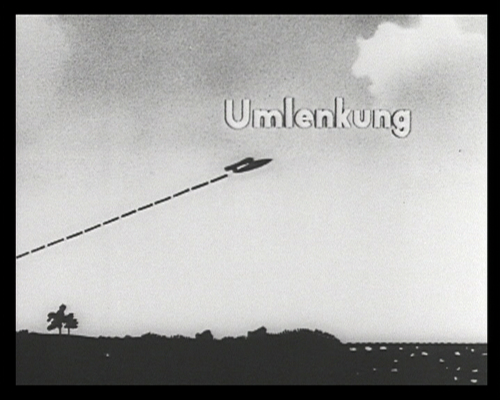
Image: still from Harun Farocki's Eye/Machine III, 2003
Farocki's large corpus of writings, particularly his essays in the now defunct Filmkritik, exist in a complementary relation to his films' apparently growing verbal reticence. Found images converse together, punctuated by measured, not to say minimal interventions that subtly underscore, nudge or counterpoint the patient, self-effacing work of montage. As Thomas Elsaesser observes in an interview with Farocki, the director is fascinated with (constant) capital's tendency to render the world superfluous – this becomes the logic of his own writing and film making, in which the author survives the demise of production as a shimmer of irony haunting every shot, reinflecting otherwise bald images of command/control with a kind of ‘grin without a cat' critique. Everything Farocki re-presents is turned ever so slightly on its axis by the process of montage, the occasional choice phrase, as in Benjamin's image of revolutionary transformation as a minimal change to the state of things that nevertheless makes all the difference. If nothing else, Farocki manages the sarcastic refunctioning of neoliberal teaching films, ‘capitalist Lehrstueck' as Kodwo Eshun and Antje Ehmann term them. A vast collective mis-education is turned against itself in films such as Leben - BRD (How To Live in the Federal Republic of Germany, 1990), the tragedy of corporate pedagogy turned into a grotesque but often highly amusing farce. Farocki's economy finds a solution to the old Adornian-Brechtian enigma of how to represent society without reducing its complexity and softening its horror by simply applying direct cinema techniques to capitalist Lehrstück. In the process both direct cinema and Brecht are dialectically transformed; filming and montaging the theatre which capitalism itself is perpetually staging and restaging in an era of accelerated restructuring and destruction turns it into satire, wordless auto-critique. Like the silent, unassigned images haunting the protagonists (and audience) of a Haneke film such as Caché, Farocki's absence leaves the images room to drown in their own uncanniness, or, as in a crystalline paean to the exquisite absurdity of commodity fetishism such as Still Life, to flicker in their bottomless ambivalence – at once utopian and ‘unimaginably' strange. Farocki reproduces a world in which imagination, and the image itself, are becoming increasingly straitened:
When you look at objects the people who produce them remain unimaginable. The spectator who understands this becomes unimaginable to himself. This is the departure for a new image of man.
The latter phrase itself reverberates in ironic ambivalence.
If devalorisation is Farocki's great theme, its primary cause, the elimination of living labour, seems to me to be the key leitmotif of his films. From the imposition of abstract labour in the phase of formal domination to the present ‘surreal subsumption' capital progressively evacuates and, tendentially, displaces work from re/production.i This theme is repeated across different cinematic registers and modes, from the symbolic and graphic figure of the worker's absent (dead) body outlined in chalk on the ground at the end of Between Two Wars (the post-WW1 revolutionary ‘gesammtarbeiter' first displaced from production then murdered by capital) to the lone worker silently superintending the automated pre-fabrication of a brick wall in contemporary Germany in Vergleich Über Ein Drittes (Comparison By A Third, 2007). Farocki presents this process of (technological) displacement dialectically, and globally, however – hence there is none of Negri or Baudrillard's one-sided totalisation or euphoria here, no simple ‘end' or ‘dematerialisation' of work. Instead what disappears at one pole of production is discovered re-emerging at another, running in strict (combined and uneven) parallel.
Comparison is a hypnotic two screen work contrasting the almost completely automated production of a brick wall in a cutting edge European factory with the very social and highly labour-intensive process of wall building in Africa. True to Farocki's notion of ‘soft montage' discussed in the essay of the same name reprinted in Against What?, one image is questioned and interpreted by another, held in a dialectical tension which forbids either nostalgia or unmediated technicist enthusiasm, neither the celebration of ‘appropriate technology' and ‘community' nor the worship of high tech and efficiency that is its complementary opposite in the global constellation of devalorisation. Farocki shows how the two poles posit and presuppose, but also interrogate and criticise, each other. The complete absence of commentary in this work is exemplary – the viewer is left to do the intellectual labour of reading and mediating the contrasting images. The most basic shot/countershot is sufficient to catalyse in the viewer an effort to narrate the stark contradiction, to somehow make sense of the coexistence of antithetical yet surely interconnected processes of (non) reproduction. The official story of capitalist progress and its contemporary extension (by evasion or inversion) into narratives of a seamlessly ‘flat' or irreversibly collapsing world, is baulked by the sheer complexity and hybridity of global production. Rather than progress or apocalypse, the possibility of a dialectical, revolutionary overcoming of the opposition sociality + poverty/ isolation + efficiency is present, but always in tension with the likelihood of intensified non-reproduction and the further deepening of the (brutal) contradiction Comparison begins with.

Image: still from Harun Farocki's Comparison by a Third, 2007
Since the '80s Farocki has increasingly worked under a self-imposed taboo against the staging of material, instead relying respectively on a very particular form of direct cinema and found footage:
No actors, no images made by myself, better to quote something already existing and create a new documentary quality. Avoid interviews with documentary subjects; leave all the awkwardness to the idiots you distance yourself from.
Eshewing unnecessary labour like a good capitalist engineer fine-tuning his critical-analytic machine, Farocki formally assimilates and assumes the same process of (self)abolition which is both capital's historic mission and – potentially – the grounds for a fully socialised, fully human technology. Farocki's unalienated labour, vanishingly thin as it becomes, is continually played off against the alienated labour his films scrutinise and seek to understand. One might question to what extent – here and in other aspects of leftist politics and culture – this ascesis is a dialectical challenge to capital or merely its double. Does minimalism shade into a moralised militantism, formal economy, as ‘negation of the negation' acting to produce a parallel politico-aesthetic devalorisation? Or, insofar as minimalism can helplessly undergo transubstantiation into the stuff of luxury (Raven Row is no third world building site), is an aesthetic of poverty – like other leftist cinematic propositions such as an ‘aesthetics of imperfection' – not doomed to become its niche marketed opposite?
But Farocki is ahead of such criticisms insofar as he explicitly thematises the contradictions of his work's own productive forces. His withdrawal from narrative cinema is at the same time, in parallel with capital's penetration of the personal, affective and communicational worlds of the (former) worker, the exploration of a vast new world of (un/productive) images. Farocki pioneers new fields and forms of image analysis by scouting the emergent scenes of capitalist devalorisation – supermax prisons, combat simulators, maternity class and police training exercise, or venture capitalist negotiation session. Capital's growing interest in training and rehearsing, simulating and re/modelling every inch of the ‘social factory' appears in Farocki's work as a project not of simple ‘expansion', but rather, I would argue, of involution and contracted social reproduction. Increasing precision is applied to increasingly unproductive and outright destructive functions. Work becomes an endlessly rehearsed performance in which nothing is re/produced but work; field of vision and field of fire merge with the gun/camera installations of the modern correctional facility. (I am thinking of Farocki's Ich glaubte Gefangene zu sehen [I Thought I was Seeing Convicts, 2000] which takes the Corcoran supermax prison in California as a site where guards effectively rehearse and stage gladiatorial combats between the inmates then shoot them down. The prison becomes a kind of (CC)TV studio churning out state snuff movies). Like a vast historical joke on the Maoist cultural revolution or Brechtian teaching programme, capital combines ceaseless re-education with the progressive scuttling of material existence.
Farocki's capitalism is not the accelerating, self-perfecting capitalism of Virillio or Deleuze, a system of diabolical, endlessly refined productivity but rather a process which for a long time has been developing through self-cannibalisation. The suspicion that Farocki surrenders masochistically to the conditions of this system by abjuring any direct expressive function of film is checked by his works own internal discipline. Instead, irony performs a dialectical escape act, rendering the muteness of developed capitalism voluble by letting its proliferating silences and scripted performances speak ‘for themselves' – ‘As if the world itself wanted to tell us something.' This adamic language is at its most amusing when the films are most ascetically reserved, witness again How To Live in the Federal Republic of Germany or Nicht Ohne Risiko (Nothing Ventured) – as sinisterly hilarious as reality TV would be if it could just shut up and pay attention to the pedagogical routines unfolding around us like a 24 hour biopolitical soap-opera. Arguably Farocki, professionally and critically involved with German TV throughout the '70s and '80s, invents reality TV in films like Leben - BRD, and to see these films today reminds us of how close this dystopian proletkult is to being a ruthless Marxian critique of everything existing.
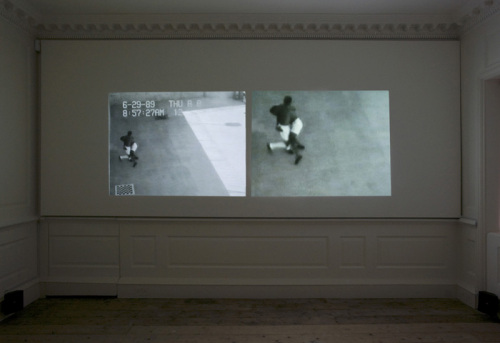
Image: installation shot of Harun Farocki's I Thought I was Seeing Convicts, 2000
So much for Farocki's formal strategy of austerity or ‘aesthetic of devalorisation'. Returning to devalorisation as ‘content', the Raven Row archive revealed a film-maker confronting capital's imperative head-on, beyond a certain point in its development, to wipe out not only over-valued exchange values (as in our current economic crisis) but, increasingly, the very forces of production – machines and humans, mental and environmental resources. Capital's drive to convert and multiply a single rationalised productive process to yield different or opposing outputs, to turn its forces of production against what it produces, remains ever present in Farocki's work. Farocki insists on the highly political nature of ostensibly neutral objects of consumption, underscoring the inseparability of productive and unproductive activity.
Already in Inextinguishable Fire, Farocki had examined the emblematic scandal of Dow Chemical, a company whose own technical efficiencies oblige it to turn its surplus (domestic, productive) output into materials for destruction and war – i.e. unsellable petroleum becomes napalm, shipped out to Vietnam where it is used to flay the bodies and environment of the ‘communist' antagonist. Rather than propaedeutically expose his audience to images of napalm's horrific effects, Farocki uses a kind of institutional tracking shot to makes visible in one movement the inseparability of the productive and destructive arms of a single company. Famously, Farocki, in the guise of a TV announcer, begins this movement by stubbing a cigarette out on his own forearm while the voice over explains that napalm burns at 3,000 degrees, a cigarette at just 400. This gesture has captured most of the discussion, but it is the succeeding sequence based around a Brechtian mock-up of Dow Chemical's internal division of labour that makes good the initial gestus (an ‘expanded reproduction' of the gesture?). The film is a study in the right hand's carefully constructed ignorance of what the left hand is doing, of a (self-)alienation which is not simply epistemological or ethical but institutional and systemic; hence Farocki's self-wounding gesture is not an actionist coup de theatre but rather a characteristically economical and accurate physical synopsis of the self-destructive (and necessary) separation that the system is predicated on. The ensuing analysis reveals that Dow is no isolated malefactor but rather simply one exemplary node in a vaster system of production/destruction. It is identified as a potential site of struggle and refusal, were the scientists employed there to start thinking their activity in its totality and practically refusing it in concert with other workers at different points in the division of labour. As such Dow is also, like the gesture of stubbing out the cigarette, only a metonym for other sites of struggle, other refusals to reproduce the structures and logic of devalorisation. Overt exhortations of this kind are notably absent from the director's later work, but the focus on the ambivalence of capitalist ‘rationalisation' remains a constant.
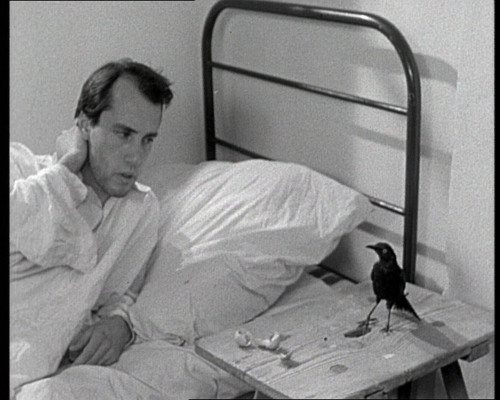
Image: still from Harun Farocki's Between Two Wars, 1978
In Farocki's films capital is a system of production, but above all of production through and at the cost of intensifying destruction. In Between Two Wars and the later film essays Wie man sieht (As You See, 1986) and Bilder der Welt und Inschrift der Krieges (Images of the World and the Inscription of War, 1988) Farocki develops the logic of Inextinguishable Fire's analysis to present a kind of Marxist version of Thomas Pynchon's Gravity's Rainbow. The recycling of waste products of capitalist and pre-capitalist culture is presented as the material for an increasingly schizophrenic and ambiguous economic expansion. On the one hand, the production line brings new economies of scale, on the other, the machine gun automates murder on a mass basis.
In Between Two Wars Farocki draws on the theorist Alfred Sohn-Rethel's Marxist analysis of the economy and class structure of fascism to posit an analogue between post-WW1 Germany and consumer capitalism after '68. In both eras the logic of devalorisation as rationalised irrationality - for example, the mass production of machine guns (and, one might add, financial instruments), as ‘solution' to an over accumulation of labour-power – is central, the answer capital gives to its ongoing crisis so as to contain and overcome the threat of a communist response. Farocki's films, in this period, seem to begin by constructing dialectical images, almost hieroglyphs for materialist interpretation. The key image of capital's self-destructive ‘recycling' in Between Two Wars is presented in a scene in which one worker tells another his dream, of a bird that hatches then eats its own egg. The second worker replies with the story of the scientist Kekulé – a story which Pynchon's novel also seizes on as symbolically pivotal. While he was working on the problem of the molecular structure of benzene (essential to Dow's later production of petrol and napalm), Kekulé dreamt of a serpent eating its own tail. His interpretation of this archetypal image of regeneration and the entwinement of life and death was radically disenchanted – the dream vision became a model for material production, stripped of symbolic meaning and turned into a topology.
Yet in Farocki's film Kekulé is not so much the spiritually impoverished seculariser of a spiritual metaphor as in Pynchon's melancholic (Weberian?) version, but rather a model of capitalist rational-irrationality. Converted into the structure for benzene, a figure of regeneration becomes real and practical. The second worker, like Kekulé, sees in the image of the bird eating its own egg a formula for immanently overcoming capital's problems, reorganising production such that the waste products of one process can help power another (‘a network of pipelines' would use exhaust gases from coking to heat blast furnaces for smelting.). The bird eating its own egg becomes the topology for the material recycling necessary to the rationalisation of production. In good Brechtian fashion the workers discuss the interpretation of dreams, the dreamer concluding (like a naive German left-communist of the era?) that science must submit itself to the imagination of labour, but that, generally speaking, the workers' dreams are instrumentalised and put to work by capital. As the film goes on to show, this first phase of devalorisation stores up a second. The image of a bird that devours its own product proves, with tragic irony, to be the emblem of the austerity of the '30s and of the succeeding imperialist war. Indeed, capitalist ‘efficiency' is shown as constitutively dependent on and productive of this austerity. The second worker's vision of the integration of different industrial processes through ‘total flow production' enables great leaps forward in output, but, once applied in practice, as in the German steel industry of the '20s, this very ‘rationalisation' results in an increasing contradiction between production and consumption.
In their essay in Harun Farocki: Against What Against Whom?, Alice Creischer and Andreas Sieckmann quote a section of the film which brings this all together:
In a scene set in 1932, the woman meets the blast-furnace man on a bridge. ‘I managed to have a look at the stenograph of a speech Hitler gave in an industrial club in Dusseldorf. If the world's entire car industry worked at 100% capacity, the entire car stock could be replaced within four and a half years. And this holds true for almost every industry. Increased production possibilities have become so high that today's market stands in no relation to them any more. [...] This Hitler guy talks like a Marxist'.
The ‘solution' to devalorisation becomes in turn its cause. And the socialists helped come up with it, playing the part of left wing of capital or better ‘the left wing of devalorisation', as Loren Goldner puts it. Excess of supply over demand and the inability to realise the value incorporated in products on the market led the capitalist class to find a new ‘solution' in the non-reproduction of workers. Having broken the resistance of the working class with the help of the unions and socialist parties, militarisation of the economy and, ultimately, war proved necessary to bring the market and the productive forces back into alignment. In Farocki's film, Nazism is revealed as the only political form capable of securing continued capitalist accumulation, projecting an image of national rebirth to mobilise and legitimate a process of social self-cannibalisation. Having perfected the Taylorist integration of production and the reproduction of workers, capital ends up, once again, micromanaging their murder. Recycling as rationalisation of production impels, as its necessary continuation, the outright destruction of value.
This contradiction between forces and relations of production and the resulting systemic tendency to self-consumption recurs across Farocki's subsequent works. Within capitalist social relations the virtuous circle of the scientist is inseparable from the vicious circle of the fascist. The bird eats its own offspring; a generation is sacrificed to ensure the reproduction of capital, not once but (at least) twice. And as Farocki's film implies, this contraction of social reproduction, this murder of the rising generations, is not a relic of the mid-20th century but very much the reality of the last 40 years' ‘neoliberal' global experiment. Moreover, Farocki's films seem from early on to refuse the comforting notion of a return to a social democratic ‘alternative' – instead they mercilessly expose the proximity of the workers' movement and fascism, of the productivist and nationalist left and right wings of socialism. Like Dow Chemical, socialism's productive and destructive arms can now be seen as inseparable, mutually constituting. The recognition may hurt, like a self-administered cigarette burn, but if one wants to stop reproducing the tragedy of capitalist ‘development' one must try and grasp it.
Deinstitutionalisation and/or Devalorisation Redux
Farocki's Between Two Wars, but perhaps even more so his film essays As You See and Images of the World, suggest the way in which the absence/elimination of the worker – in particular of the worker as conscious revolutionary subject – coincided with the consolidation of the worker as an identity. The same dialectic of devalorisation as a simultaneous affirmation and suppression of labour can be seen in the evolution of the form and content of cinema itself. The Raven Row show's installations, particularly Zur Bauweise des Films bei Griffith (On Construction of Griffith's Films, 2006) with its analysis of the invention of shot/countershot as a recalibration of the cinematic law of value, and Arbeiter verlassen die fabrik (Workers Leaving the Factory in Eleven Decades, 2006) enabled one to trace this evolution forward from the birth of cinema and the rise of socialism to the present crisis – of politics, economics and the moving image.ii
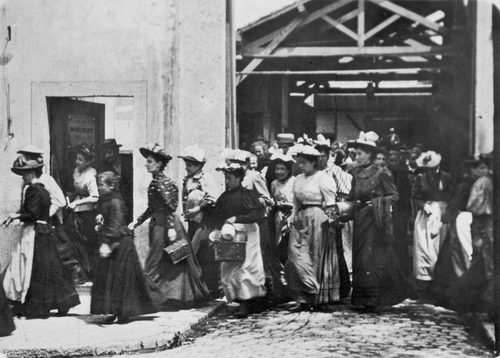
Image: still from the Lumières' Sortie des Usines Lumière à Lyon, 1895, used in Farocki's Workers Leaving the Factory, 2006
On Construction reveals the logic of Taylorism operating in cinematic form. The introduction of the shot/reverse shot gives us two sets for the price of one and enormously increases the transferential ‘productivity' of film grammar in the process. The individual performer's affective ‘output', and the integration of the viewer/consumer, is redoubled, while, arguably, the material conditions for the mass production of ‘stars' out of mere ‘actors' is put in place. The (abstract and abstracted) labour of the actor, like that of the factory worker, is further broken down into parts. It becomes at once more fascinating (for the viewer) and more boring (for the actor) – standing around waiting to manufacture torn halves of a virtual encounter; as Deleuze suggests, cinema acting becomes increasingly a matter of reacting.
The dialectics of (abstract, industrial) labour in cinema are pursued again in Workers Leaving the Factory. A row of 12 monitors showing excerpts from 11 decades of feature, documentary and promotional films, Workers does what it says on the can and shows workers leaving factories. It is not only a document of the evolution of film and of factories but, as Bert Rebhandl puts it in Against What?, it posits the continual ‘reappearance' of the Lumières' first film – the primal scene of workers exiting the inventors' photographic factory in Lyon (Sortie des Usines Lumière à Lyon, 1895). Farocki selects images of the literal departure of workers (or actors playing workers) from factories in films such as Intolerance, Metropolis, Modern Times, Il Deserto Rosso, and Dancer in the Dark as well as documentaries and documentary footage including a short scene outside a factory in Moscow from 1912, and La reprise du travail aux usines Wonder from May '68 (a Parisian worker who is leaving work when her bosses and union officials would like her to return: ‘No, I will not go back. No, I will not go back in there. I wouldn't put a foot in that prison. You could see what a shithole it is.'). Workers, by condensing film and labour history into a few screens and scenes, foregrounds the general absence of the factory as a subject in cinema. Without commentary, the installation implies that the cinematic apparatus is founded on a constitutive disavowal of production, both the world of industrial work from which the cinema classically posed an escape, and its own fantasmatic production line – the Taylorist, 24 frames-per-second machine behind and within the projected image.
As well as staging a cinematic ‘return of the repressed' – of work, and indeed of class struggle – Workers is simultaneously an analytic cross section in 12 slices of the long arc of the workers' movement: from revolutionary challenge to capital to vanguard of real subsumption to anti-bureaucratic revolt and on into a post-Fordist afterlife in which the installation itself (‘the line' become a line of monitors) represents the worker as revenant – since art spaces such as Raven Row are themselves sites of former industrial or artisanal labour. Hito Steyerl has wittily formulated the dialectic of the factory and museum that arises at the end of this arc in her essay ‘Is the Museum a Factory'. Rather than protesting the inappropriateness of showing radical film in the museum, she argues, we could say that the museum has simply returned to its original function: Factory - Museum - Factory, to refunction Marx's formula for the circulation of capital (Money - Commodity - Money). What this analysis misses, however, is the way in which the F-M-F spiral is not at all the upward movement of valorisation, M-C-M' (Money - Commodity - Money ‘plus an increment of surplus-value'), in which capital grows by being admixed with living labour. It's more of a downward spiral. The conversion of (no longer) productive factories into unproductive sites of consumption has served to expand fictitious capital, property values and the rest of the F.I.R.E. (Finance, Insurance, Real Estate) economy, but contributed precious little to the extraction of surplus value. The neoliberalised museum is more like a supermarket, the radical art space an organic farmer's market, in which a narrow section of the global unproductive classes g(r)aze more or less intensively while, through their presence, performing a rite of (fictitious) revalorisation upon the tranche of deindustrialised sub/urban space in which the museum or gallery is situated.iii
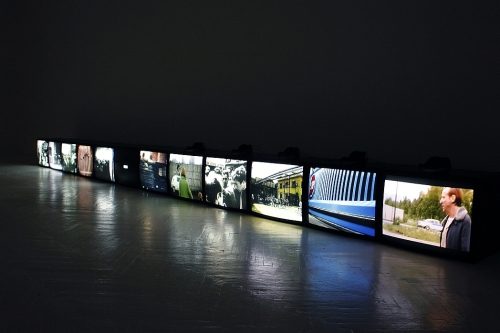
Image: installation shot of Harun Farocki's Workers Leaving the Factory in Eleven Decades, 2006
That this is part of the movement of devalorisation in its current form of advanced non-reproduction is shown in the signal failure of such performances to produce anything other than claims on value that is extracted elsewhere in the circuit of capital. The institutions of the cultural economy are now facing collapse and may well seek bail outs by private (even oligarchic?) capital. The museum as factory will have functioned at best as an advertisement for a new phase of accelerated looting – as in the case of Riga's new art museum. In this respect Farocki's Raven Row show was especially timely, and the question Against What? Against Whom? pointedly apposite given that Farocki's new visibility in the London art world was itself facilitated by Raven Row's director, heir to one of the great agents of the 20th century devalorisation of British labour-power, J. Sainsbury. As such the show marked the convergence, if not reconciliation, of the two wings of capitalist devalorisation. Socialist guerilla film-maker meets repentant scion of (super)market capitalism in neoliberal infinity. In an era of open capitalist crisis, the field of vision (or ‘distribution of the sensible' as Rancière would say) would seem once again to be undergoing a reconfiguration, the ‘operationality' of images – including expressive or critical images – is being recalibrated. Crisis not only resets the measure of value by driving down the price of labour-power, but sees a re-evaluation of underappreciated art. That which was shunned as ‘didactic' returns as a purgative for a bloated art market, while ‘hairshirt radicalism', as J.J. Charlesworth calls it, can easily end up reproducing an ideology of morally virtuous belt-tightening, making do and getting by. Among the middle class (and many artists) there is plenty of this sacrificial socialism which says we all have to take a bit of the pain if ‘things are going to get better'. As in the '20s and '30s, capitalism can today use remnants of leftist culture and its archive to provide cheap content (viz the ICA's ill-fated ‘radical experiment in deinstitutionalisation') and an ideological justification for austerity.
Consequently at the top end of the capitalist circulation of goods, austerity coincides with a promotion of ethical, intellectual, politicised and above all cheap art work. Of course this coexists with a ‘reactionary' lunge back to proven national brands – the ICA plans to reboot with a show of Jake and Dinos Chapman's work – but the utility of a left-wing ethos of DIY autonomy, restraint and economy in a period of deflation is not lost on capitalist institutions in crisis – both in the culture sector and in the EasyCouncil-style (private/)public sector beyond. The apparently incongruous convergence of private capital and political art and film is a straw in the wind indicating the imminent collapse of the neoliberal cultural surrogate for a ‘public sphere' that succeeded the state-funded regime (Arts Council and the dole). The eclipse of state funding will see the emergence of other sources of individualised private-public patronage, but their tastes may well be less ‘radical' than Sainsbury's. If the general tendency of recent decades is anything to go by, the new patrons could end up more on the model of Anita Zabludowicz (director/proprietor of 176 art space in North London) than Alex Sainsbury – the wives of arms' manufacturers and oligarchs, their tastes and commitment as fickle and superficial as Sainsbury's is informed and (comparatively) sustained. Even the most intelligent and engaged patron represents part of this wider process of cultural non-reproduction; new patrons, whether their money is new or old, are by their nature more autocratic and unaccountable than public bodies. Not to fetishise the latter, but their contraction or collapse is one more symptom of the ongoing destruction of value by and for capital; a ‘liberation' from bureaucracy, maybe, but from funding, definitely.
In this sense, I think we can take a page out of Farocki's analysis of Dow Chemical and see, behind the benign and human face of the ‘good' reproductive capitalism of Sainsburys and socialism, the true and destructive, devalorisationist economy of Zabludowicz. Behind the petrol, the napalm; beneath the farmer's market, the occupied settlements of East Jerusalem. And, lest this be misunderstood, this is not a matter of scapegoating any particular branch of capital or its bearers, the truth of the Sainsbury-Zabludowicz continuum (the shot and counter-shot of a process of contracting social reproduction, as it were) is not discovered by collapsing one into the other, but rather by seeing both as necessary to the continuation of accumulation – cultural and general.
Whereas scapegoating works by announcing the disciplining or even elimination of one part of capital, along with a portion of the working class, we should invert this dodgy equation and extend our critique from a fraction of the system to its totality. At the (rather over stage-managed) panel discussion for the launch of Against What/Against Whom? Kodwo Eshun seemed to cheerfully invert or abbreviate the lesson of Inextinguishable Fire. Celebrating the ‘liberating' post-crunch opportunity for naming and blaming culprits (evil bankers) in isolation worked to reverse or at least impede the movement of Farocki's montage. Stubbing a fag out on the ‘bad' financial arm of capital, or indeed the military arm of the culture-finance-military-(post-)industrial complex, may be a pleasure but is it any use when it leaves the relations of part to whole unexamined? The media heaves with naming and blaming ressentiment patently aimed at misdirecting any burgeoning opposition to the system as a totality. In the end the new liberal/artworld tolerance for a sub-Brechtian ‘crude thinking' of the kind that remains too ubiqitous in political art, reveals the superficiality of the politics as well as the aesthetics. Analysis lacks engagement with class as a decisive and relational rather than subsidiary and sociological concept – form, as in the value form AND aesthetic form (and the latter as a mode of exploring and opposing the former) is dominated by a rigid and politically correct combination of formalism and content-ism. Even most of the articles in Against What?, for example, which includes detailed discussions of Farocki's early attempts at Marxist pedagogy, seem to do without a historical-relational conception of class, if indeed class is mentioned at all. Foucault generally takes presidence over Marx, yet Farocki's films seem as much concerned with value as with control and ‘biopolitics'. In fact by exploring the link between these things/processes in a way which at least implies labour-power as a central category, Farocki's films and writings manage to be much more penetrating than many of the readings produced by their academic fans.
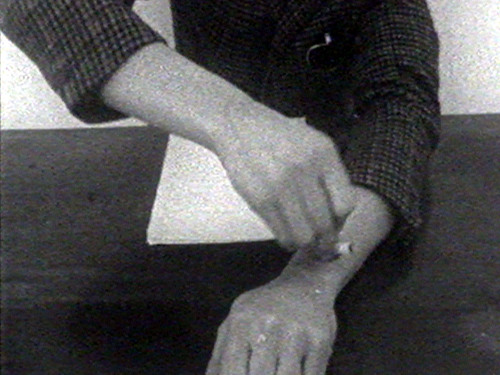
Image: still from Harun Farocki's Inextinguishable Fire, 1969
Unsurprisingly, in the absence of an analysis of class as relation, of labour as embodiment (and antagonist) of value, there is little discussion in this milieu of the myopias of leftist film. Not to mention the assumption – apparently alive and well – that the political insights of a fraction of the bourgeoisie have a privileged analytic or indeed practical value. Looking back from our present crisis to the social revolution of the '60s, in fact, one could argue that Farocki and his peers were actually in the rearguard of a proletarian refusal which did the real thinking, the active theorisation and education work, through the practice of the wildcat strike and the urban riot. We can propose a countershot that upsets the received idea that the ‘return' of the left to the cultural centre marks the renaissance of a repressed radicalism. What if the left who now return to denounce neoliberalism in crisis were, in their own youth, simply the vanguard of the retrogression that followed in subsequent decades?
The notion is not completely alien to Farocki. Having explored the complicity of the socialist movement in devalorisation in Between Two Wars, later films such as Etwas wird sichtbar (Before Your Eyes, Vietnam, 1982) engaged critically – but ambivalently – with the continuation of this legacy in the anti-imperialist movement of the '60s: ‘I had sided with the Vietcong without dealing with the politics of the victorious communist regime and without mentioning the boat people or the detention camps,' he confides in Against What? In ‘Dog From the Freeway', a text which accompanies Before Your Eyes, Vietnam, Farocki criticises the ‘identical mental mechanisms' of denial of the China-Cambodia and Soviet Union-Vietnam factions. Nonetheless he also retained loyalty to the ‘historical character' of the nationalist opposition to US imperialism and seems enthusiastic for the figure of the partisan and the guerilla activity of the Vietcong which here eclipses any notion of the revolutionary working class as primarily non- and anti-state (‘The working class and the employing class have nothing in common' as the IWW put it). The partisan is not the conventional soldier, yet as Carl Schmitt grasped, is a kind of microcosm of the state, an avatar who is given historical and intellectual consecration with the rise of the modern bureaucracy – not so much its other as its Clausewitzian continuation by other means. As such, those attuned to the predominance of a Hegelian ‘negation of the negation' statist perspective in 20th century socialism will recognise the dead hand of devalorisation behind the romantic figure of the freedom fighter.
In Farocki's essay, however, the ‘participative' and active citizenship promoted by the Vietcong is not subject to critique as the very form of a (bloody) capitalist agrarian revolution. For all Farocki's attentiveness to the manipulation of atrocity images by both ‘communist' sides and the ugly contradictions confronting the nationalist anti-imperialist position, he never seems to draw the logical conclusion – that the enemy of workers and peasants was not only American imperialism but their domestic bourgeoisie. This is a far cry from the prescient analysis of the Situationist International back in 1967: ‘The point [...] is not to give unconditional (or even conditional) support to the Vietcong, but to struggle consistently and without any concessions against American imperialism...' Although presumably Farocki would agree that ‘The Vietnam war is rooted in America and it is from there that it must be rooted out.'
With this tragic socialist betrayal of the working class in mind, one must wonder exactly how far one can rely on the teachings of Farocki. To what degree does the theoretical and practical elision of the working class as self-subsisting positive, as a form of activity radically opposed to the dialectical labour of negation of the Prussian state bureaucrat and his 20th century descendents, render Farocki's criticism of the image, of work, and of capitalist ideology itself complicit in the ongoing capitalist project of devalorisation? This particular absence/elimination of the working class – the one staged and re-staged by their social democratic, anarchist, and Trotskyist representatives – is the most serious one ‘in' (but never confronted by) Farocki's films.
Returning to the current struggle in the cultural sector, we can re-examine the question of what is at stake here. Despite Hito Steyerl's caveats, the (ongoing) return of radical cinema – first time in factories, second time in factories-turned-galleries – still seems farcically emptied of (the) class as such. One might hope that the current ejection of the gallery from the converted factory will produce a new class consciousness among those affected, but so far even this dialectical twist in the conversion spiral doesn't seem to have had much power to consolidate resistance. While the non-reproduction of the non-reproductive sector could be seen as one of the first tasks of revolution – capital doing our work for us - in this historical juncture I suspect it's a sign of weakness not strength: the lack of opposition at the deluxe end of the market reflects a wider passivity and insecurity. The division of labour which Farocki has sedulously explored in his films has evolved to the point where opposition may be less a matter of coordination across sectors – as espoused in Inextinguishable Fire – and more of an all or nothing rout or exodus. Having said that, a revolution without a programme for social reproduction as well as the abolition of work could be an even more effective agent of social contraction. Again, films such as Between Two Wars are a salutary reminder of capital's ability to raid the ‘dreams of the worker' and put them to work against them.
The Self-Excluding Worker
As I was watching Between Two Wars on the monitor in the entrance of Raven Row an actually existing proletarian, drunk, shouting, clutching a lager, burst in through the elegant Georgian doors of the white cube. He didn't hang around long enough to be ejected, but leapt back out almost instantaneously. It was tempting to consider this undisciplined, post-Fordist (non)worker as the missing final screen in Workers Leaving the Factory. There was something hallucinatorily absurd and scandalous about his brief visit, like an eidetic image of the supposedly ‘real world' which being in a gallery always conjures up (La vraie vie est ailleurs) but which almost never breaks in on the interior spectacle. The intruder/extruder was like the (bad) supplement to Farocki's haul of departing workers, the human surplus displaced by the super-efficient automated factory gates shown on the 11th monitor, perhaps. This real-life performance of the contemporary ‘eliminated worker' was, by contrast with How To Live's pageant of capitalist re-training exercises, completely unscripted, a ‘free improvisation' albeit a solo one. This was the pedagogy of (as in by) the proletariat – not scored by capital for labour's edification, but rather precision targeted, by accident, at the critic of self-critical leftist cinema – me. (Or was this just the typically narcissistic delusion of the film-viewer?)
In this case the worker was self-ejecting, appearing and disappearing without a trace. But his ad hoc intervention was enough to make the historical dialectic of labour's dis/appearance clearer. What Hollywood screened out – the factory – and socialism deified – the worker – it simultaneously destroyed; devalorisation made visible what it sought to eradicate, simultaneously consigning much of the labour force to the status of invisible non-People. The elimination of the worker coincides in the phase of Fordist devalorisation with a cult of the worker as identity and a cull of those identified as non-workers (Farocki's Images of the World is devastating on the Nazi deployment of this distinction in the camps, the exemplary space of capital's decision over life/death in terms of work/non-work). If the process begins with the birth of cinema – with the image of workers leaving the factory – in the present moment of crisis this displacement has come full circle; the museum as (social) factory is closing down all over the shop, everywhere we look the exit from the factory is being forcibly levered open and the worker expelled – by capital. The charade of cultural value production is discovered as a sham extension of a wider fictitious capital bubble. Rather than running for the exit, workers may think of occupation, or indeed of new forms of solidarity capable of turning this new ejection to their own advantage, a step – or leap – toward their self-abolition as capital. Meanwhile, the worker is said to remain absent from the stage of history, this time not concealed behind the reformist/devalorisationist carapace of a heroic identity but diffused, disaggregated, alienated from any class consciousness. It's ambiguous - is this the condition for the complete self-abolition of the working class or the current limit of anti-capitalist struggle? Either way, the worker who accidentally and drunkenly enters the art/politics factory is immediately repelled by sober acts of attention to black and white screens – perhaps he even glimpses Workers Leaving the Factory at the back of the space – and recoils?
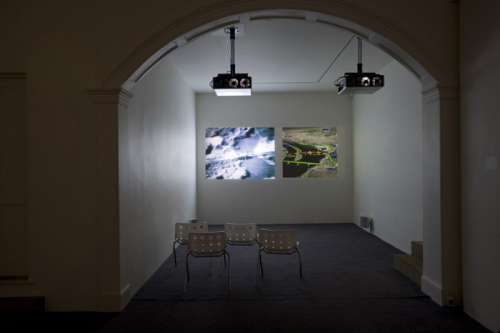
Image: installation shot of Harun Farocki's Eye/Machine III, 2003
Whether or not any of the current politicised discussion in cultural institutions amid cuts and lay offs, both front of house and behind the scenes, has any bearing on a resurgence of working class self-activity remains to be seen. What seems more certain is that while any real social movement opposing capital is absent in the UK, cultural workers discussing political action helplessly reproduce the position of an earlier generation of vanguardists. This is politicisation in an (aesthetic) vacuum, an empty space apparently increasingly dependent for its existence (inflation?) on the largesse of private capital. The absence of the working class is thus as ambivalent as ever – my guess is that Farocki's current art-world sponsors represent the displaced last gasp of social democracy, the final convergence of the mainstream and left-wing of devalorisation in a privately funded non-market gallery space. Is it a shame that the undisciplined worker who burst through the door just as quickly burst back out? Or is the indifference of actually existing workers to the pedagogy of the left in itself a result of the definitive historical overcoming of social democracy? With no class identity to affirm, perhaps the class's self-abolition is immediately at hand, the worker just needs to walk away from the machine, to take the final step on the path.
Maybe – but as Farocki's films show us, the global proletariat is definitely unevenly developed, and not yet consciously combined in its opposition to what passes for ‘development'. At the poles of capitalist (non/re)production workers are either too many or too few, labour is engaged in a charade of activity that is technologically superfluous. Increasingly, as Farocki's films suggest, one is dealing with ‘guard labour', the warehousing, surveillance and/or destruction of one fraction of the class by another. (If the worker-intruder had hung around long enough, other workers would have been on hand to remove him. Or, better/worse, perhaps he would have been invited to stay and watch the installation?) Farocki makes difficult viewing for anyone, much of the material is grim, much is absurd, and it relentlessly abstains from cheap visual pleasures. It is the anti-action film, ‘thrillers for those bored by thrillers', as Kodwo Eshun and Antje Ehmann put it. Yet, as such, action – activity – remains his subject, even if this activity is theoretically - not to say practically, historically – entwined with its containment by the value form and those who ambiguously represent capital and/or its negation. Whatever the limits of his politics, Farocki continues to put the question of the abolition of (alienated) labour at the centre of his work, economically and elegantly precipitating thought by re-presenting images of the world inscribed and disfigured by value in crisis.
Info
Against What? Against Whom? was at Raven Row, London, 19 November 2009 - 7 February 2010
This project was linked to 'Harun Farocki. 22 Films 1968–2009', a season of single-screen films and events at Tate Modern, 13 November–6 December, curated by Stuart Comer, Antje Ehmann and the Otolith Group. http://www.tate.org.uk/modern
Kodwo Eshun & Antje Ehman eds., Harun Farocki. Against What? Against Whom?, commissioned by Raven Row, published by Koenig Books, 2010
Footnotes
i For more on ‘surreal subsumption' see my ‘Drowning by Numbers - The Non-Reproduction of New Orleans', in Metamute, December 2006, http://www.metamute.org/en/Drowning-by-Numbers : ‘After devalorisation, that is the destruction or ‘non-reproduction of labour power' through (Fordist) recomposition, today we have the final stages of devalorisation through its post-Fordist decomposition. After the ‘real subsumption' of the worker under capital, we have surreal subsumption: the return of absolute surplus value extraction in formerly relative surplus value centred economies. Coupled with intensified labour, multiplied by primitive accumulation, capital now attempts the destruction of already reduced standards of living and expectations on the part of already ravaged communities of workers.'
ii ‘With the introduction of shot-countershot, the room was divided into two, making two sets out of one, just as the introduction of industrial production introduced the evening shift' – Harun Farocki, ‘Shot/Countershot: The Most Important Expression in Cinematic Law of Value', quoted in ‘Ato Z of HF or: 26 Introductions to HF by Antje Ehmann and Kodwo Eshun in Against What? Against Whom?) and Arbeiter verlassen die fabrik (Workers Leaving the Factory in Eleven Decades, 2006).
iii Ironically, but appropriately, Steyerl's essay on E-Flux is illustrated with images of the new OMA-designed art museum in Riga, Latvia, which opened just as the country's fictitious capital and primitive accumulation based economy collapsed. So much for culture as a site of value production – though as a catalyst to loot it clearly still has a future. Cf ‘You Think Greece Has Problems? Latvia's Road to Serfdom' Michael Hudson and Jeff Sommers, http://www.counterpunch.org/hudson02152010.html
The attempt to fashion a surrogate ‘public sphere' of political action in cultural institutions is at best a utopian complement of this primitive accumulation process, something which may remind us of the ambiguous position of the Constructivists within Soviet war communism, cf T.J. Clark's Farewell to an Idea.

Featured in Mute Vol 2, No. 16 − Real Life Training